


 SIGN UP FOR OUR
  A dear reader named Brad recently left the following question in our Facebook profile:
“[I would like to know] about good, affordable day trips in and around the SJ. I get a lot of visitors and they are always interested in them.”
Hello Brad, thanks for your question. Most tourists come to Costa Rica looking for eco-adventures, surfing, fishing, or relaxing at any of our pristine beaches. Our capital city often gets overlooked by tourists who see San Jose as just another transportation hub. Even thrifty backpackers arriving at Juan Santamaria International Airport (SJO) frequently hit the hostels and later the bus terminals where they can depart to our tourist hotspots in the provinces.
Those who don’t take a little time to explore San Jose are truly missing out on some nice, inexpensive activities.
The city of San Jose lies within a county in the center of the Central Valley, the heart of Costa Rica. It is spread out within an area of about 45 square kilometers, and enjoys great weather most of the year. The rainy season is from May to November. San Jose is an urban enclave where more than two million people live, work and commute on a daily basis. As the country’s prime center of business, commerce, politics, and transportation, the pace of life in San Jose can seem truly hectic; especially to those who are used to the far more bucolic and idyllic towns in the rest of our country.
From Monday to Saturday, San Jose is witness to a battle between pedestrian and vehicular traffic competing against public transportation and street vendors, both authorized and otherwise. The main traffic arteries are constantly jammed and the hyper-kinetic levels of activity and noise can be overbearing to those not accustomed to third world urban centers. This is particularly the case in the central districts of Carmen, Catedral, Hospital, and Merced, but outside of those areas San Jose offers quiet pockets of interest and hidden gems like forest canopy tours and zen gardens.
The next time you are in San Jose, you may want to take some time out to take on the following five urban activities, which all take place within the territorial limits of the inner metropolitan area. There are even more things to do in the Central Valley beyond San Jose’s inner city limits; a trip to of our beaches, National Parks or volcanoes can be easily arranged in a day, but if you are feeling frugal and short on time you may consider the following adventures:
1 – The Peace Parade
After enjoying 60 years without an army and having successfully negotiated the ending of the proxy fighting between the Cold War powers in the 1980s, the charismatic and rising politician Mayor of San Jose, Johnny Araya, commissioned a special celebration of Costa Rica’s love for peace and democracy.
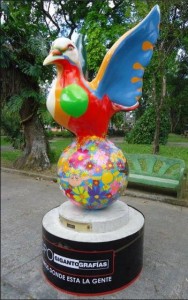
The Peace Parade is an exhibition of 70 colorfully decorated doves placed many of San Jose’s landmarks. The savvy Mayor reached out to corporate and civic sponsors to donate and decorate the doves, meaning they had to shell out money to participate, and in return they received free advertising and were mentioned in a press release. Sponsorship of each dove ran up to $36,000, and the project was budgeted to yield a 20 percent profit to be donated to ten needy schools around the country.
Each of the winged peace symbols sits upon a recreation of our mysterious stone spheres, which is one of our oldest symbols of our pre-Columbian era. The strategic placement of the Peace Parade makes for a very enjoyable walk and scenic around San Jose. The doves are split among two groups: Blue and Red. The Blue trail of doves is located in eastern part of the inner city, where some of the doves sit in leafy suburbs. The Red trail begins in the middle of the lake at La Sabana and continues west towards the heart of San Jose; it is a more challenging urban walk than the Blue trail.
The Municipality of San Jose published a handy map of both trails (PDF) pinpointing each dove’s location. There is an unfortunate mistake in the map, as some of the doves’ locations are mislabeled, but the map legend is correct. You will probably want to put on your walking shoes and carry a water bottle, especially for the Red trail. Both trails extend over several kilometers.
The Red trail begins in La Sabana across from the upscale Corobici hotel, continues north towards the Leon Cortes statue outside of the Museum of Art (which used to be our international airport terminal), and heads into the park towards the lake. There’s a dove in the middle of the lake, one on the shore, and one due west. Five more doves are located around our Chinese-donated National Stadium, and two more due east. The next set of doves can be found by walking west on Paseo Colon and merging into the Avenida Central pedestrian boulevard. From there on, there are about a dozen doves to be found on the boulevard and past Plaza de la Cultura to the Hotel Presidente. That’s the end of Red trail, which meets with the end of the Blue trail.
The Blue trail begins at the Holiday Inn hotel and continues slightly northeast to the Simon Bolivar City Zoo in Barrio Otoya. From there a couple of doves can be found in front of the old Art Deco entrance to the Hospital Calderon Guardia in the historic and upscale Barrio Aranjuez. Walking south under the railroad tracks will lead to our beautiful National Park, where some of the most photographed doves can be found. At the southern end of the park there’s another pedestrian boulevard where you can walk past the bullet-ridden walls of the National Museum and our National Assembly. More doves are located in the Democracy Plaza between the National Museum and the Souvenir Marketplace. From there it’s a short walk south to our handsome Judicial Complex and west to the Fine Arts Plaza in front of La Soledad church. There is a statue of John Lennon sitting in a park bench. From there on the walk turns uphill on another pedestrian boulevard on Fourth Avenue, where more doves can be found in the Social Welfare Park, along the boulevard, ending at Central Park (the first space to be commissioned for the public) where four more doves are exhibited.
The Peace Parade began in December and was planned for three months. It is uncertain if it will be extended; there are requests from the public to do so, but the doves are destined to be auctioned to collect even more funding for needy educational centers. It is expected that the well-to-do in Costa Rica and even some individuals and organizations outside of the country will engage in heavy bidding for the historic peace doves.
2 – The Okayama Japanese Park and Zen Gardens
In San Francisco de Dos Rios, there is a park that was planned to commemorate 30 years of city sisterhood between Okayama and San Jose. There is a huge tree in the Okayama Park that may seem out of place with a traditional Japanese park, but it’s a carryover from the former football field upon which the park now sits. Ticos enjoy old trees and would rather build around them if possible.
The Okayama Park follows the principles of Feng Shui and Zen rock gardening. There is a space reserved for graffiti artists and another one for children to play in. The City of Okayama donated a nice statue of Momotaro, a key figure of Japanese folk tales. The park includes Japanese gardening staples such as spring fountains for waterfowl, amphitheaters, gates, a white-rock Zen garden, meticulous landscaping, and bamboo structures.
Getting to Okayama Park can be accomplished by bus or by taxicab (about $4). For those traveling by cab, it’s easier to indicate the driver to take you to the Parque Chino -this misnomer is an old language relic from the old Chinese gardens in the Morazan Park.
3 – The Historic Walk Around San Jose.
The Municipality of San Jose recommends this self-guided tour on foot for those who wish to visit several landmarks in one walk. Starting at the John Lennon statue in front of La Soledad and continuing about a block north you’ll start the walk east on Second Avenue. The Souvenir Marketplace, Democracy Plaza and National Museum can be appreciated along the way.
Just like the Blue dove trail of the Peace Parade, continue to our National Monument on to Third Avenue and turn west to see the National Library, the National Culture Center, the Peace Garden, the Juan Vasquez de Coronado Monument, and the Morazan Park. Cross the park to get to Plaza de la Cultura and the Pre-Columbian Gold Museum and National Theater. From there it’s just a short walk west to Central Park, and north to our Central Post Office. Turning around and heading west on Central Avenue a couple of blocks ends the tour at the Central Market where cheap meals can be enjoyed.
4 – Forest Canopy Adventure in La Sabana
While Monteverde offers some of the best in canopy and zip line experiences in Costa Rica, city dwellers can always enjoy a round of canopy around La Sabana.
The adventure begins in the southwest corner of the La Sabana metropolitan park, and it consists of eight cable lines and a monkey ladder that traverse many of the tree species in the park, both native and exotic. The entire lake can be flown over hanging from a cable. The tours are open from 8am to 5pm. To get there, take any of the Sabana Estadio buses or jump in a cab; from downtown it’s only a couple of dollars.
5 – Children’s Museum
Located in a historical structure just north of downtown San Jose, our Children’s Museum used to be a military fort and prison. Since 1994, it has kept a number of fun and educational attractions just for children, mostly about the physical sciences and environmental issues.
Children under 12 get in for free; for adults the entrance costs between $5 and $8. On any given day, the museum offers free workshops in conjunction with the National Museum. The museum is just a short walk or cab ride away from downtown.



