


 SIGN UP FOR OUR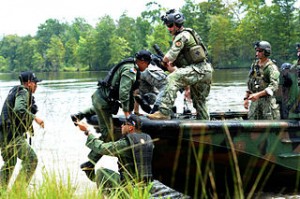
Panama Police Trains with US Special Forces. Source: Wikimedia Commons
Roger Soto Zotela, a 35-year Costa Rican citizen, was shot and killed by an undercover agent of Panama’s Direction of Judicial Investigations (Spanish acronym: DIJ) last Wednesday, according to news sources in that country.
Newspaper El Siglo reported that undercover policemen from the Chiriqui region of Panama were conducting a sting operation in the border region of Paso Canoas when Mr. Soto was shot by one of its members. A prior investigation alleged that an international car theft ring operated in Panama and was engaged in smuggling stolen vehicles into Costa Rica.
Online news daily Next Panama had more details about the incident. Citing sources familiar with the investigation, Mr. Soto was called by the undercover agents to cross the border into Panama and drive a bait car and a passenger into Costa Rica. The passenger was an undercover DIJ member anxious to make an arrest.
As Mr. Soto drove in the bait car towards the border crossing point int Paso Canoas, the undercover agent from Panama identified himself and told the agent to stop the car. Mr. Soto demanded that the agent leave the car and began to forcibly remove him from the vehicle. At that point the agent pulled out a handgun and shot the Tico auto mechanic at point blank.
Paramedics from the town of Bugaba rushed Mr. Soto to the Pablo Espinoza clinic in the community of Concepcion, but he died from his wounds before reaching the emergency room.
Relatives Call for an Investigation
The information released by the DIJ in Panama on the incident has been murky thus far. It is not clear if Mr. Soto traveled alone, since another Tico was arrested at that location and two unknown men fled the scene.
The brother of the deceased, Alvaro Soto, is demanding an investigation into the circumstances of Roger’s death at the hands of the Panamanian authorities. He spoke to Next Panama:
“What we really want is to clear things up. We want to know why he was hot, when on that day he was called to repair a disabled vehicle on the side of the highway. We were also told that he was on Costa Rican soil when he was shot.”
If the bait car did not cross the border into Costa Rica, the DIJ agents would have no evidence that Soto was involved in an international car theft ring.
Don Alvaro Soto is calling on Tico authorities to investigate the matter. Relatives of the deceased were not allowed to identify the body until yesterday, five days after he was killed by Panamanian police. They doubt the integrity of the police and coroner’s report, and they also point out that there may be sovereignty issues at hand since no Tico authorities were called in.
Don Roger Soto leaves behind a widow and three daughters, aged 4, 6 and 12.
The Questionable Track Record of Security Forces in Panama
The citizens of Panama and human rights organizations are concerned at the increasing civil rights violations by police units in that country. Allegations of brutality, violence and corruption have clouded the Panamanian security forces in the last few years; in the meantime, crimes are constantly reported by the people and the media but downplayed by public officials.
In 2010, Human Rights Watch condemned the actions of Panamanian riot police responding to a workers strike in Bocas del Toro. Press corps and witnesses reported 10 people killed by government security forces, but public officials reported only 2.
In 2011, a doctor complained that several members of the National Police Force in Panama beat him up and caused him severe injuries because he talked back at them during a roadblock. No charges were filed against the doctor until he went public with this complaint.
In late March, a reporter and filmmaker from Al Jazeera traveled to Panama to talk to members of the Ngabe indigenous people (also indigenous to Costa Rica) who were abused by police earlier this year during a demonstration in which they blocked government efforts to build a hydroelectric project on their land.
Reporting on the events surrounding that demonstration, Glen Ellis wrote:
“The police, who human rights observers say have become increasingly militarised since Martinelli became president three years ago, launched a vicious crackdown, cutting communications with the outside world, and allegedly shooting innocent bystanders as well as peaceful protesters.
Harrowing reports surfaced of rapes and the mistreatment of detainees, as scores of Ngabe men, women and children were arrested. At least two people were killed and many more were injured. The crackdown lasted for three days and proved so unpopular with Panamanians, that Martinelli was forced into negotiations with the Ngabe.”
Like Costa Rica, Panama abolished her army by constitutional mandate. In 1994, military units in Panama were converted into a Public Force, but some citizens think that the move was mostly a PR effort and that their policemen are worse than rogue soldiers. When the excesses of the police in Panama are reported by online news outlets, readers are quick to comment on the sad state of affairs, with some writing: “we were better off with the army.”



