


 SIGN UP FOR OUR
 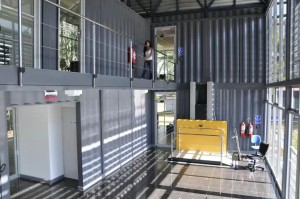 Students of the Faculty of Industrial Design at the Institute of Technology in Costa Rica (TEC in Spanish) in Cartago are enjoying a new and unique laboratory facility. Eight intermodal containers, also known as conex boxes, that were once used for shipping have been smartly recycled into a new structure that will house four laboratory facilities for media, robotics, 3-D modeling, and Information Technology.
According to the Press Office at TEC, this laboratory building is the first of its kind in Costa Rica. The eight shipping containers, each measuring 40 feet in length, were put together and repurposed in less than a year. The idea began with former Dean Gianniana Ortiz, who was seeking an inexpensive solution that could be constructed in a short time.
Since the project is ultimately of benefit for the Industrial Design students, they were the ones who set out to plan the new structure. Two faculties and the school administration collaborated. The planning took longer than the actual building; as the containers arrived within two weeks of their order and the construction finished five months later.
A Learning Experience
The students involved in the project were somewhat familiar with the use of containers. They were studying the work of renowned Tico architect Benjamin Garcia Saxe, the man behind the Containers of Hope project. Benjamin’s work with containers has thus far been limited to residential structures, and the TEC students drew inspiration to build a large utility structure instead. The Costa Rica Star has written about Benjamin and his smart and elegant residential designs in a previous article.
The new laboratory at TEC was built with conservation and sustainability in mind. The exterior walls are bare -for the time being- and it is obvious that the lab was put together with conex boxes. In the future, the exterior walls will be covered in green, as vine plants will cover them. The building complies with fire, seismic and handicapped access code. Students are encouraged to use the stairs to get to the second floor, but a forklift has been repurposed to power the elevator. Natural lighting and air flow have been maximized thanks to clever industrial design.
In the end, the 307 square feet lab cost about $238,000 to build. TEC plans to incorporate the lessons learned into future construction projects.



