


 SIGN UP FOR OUR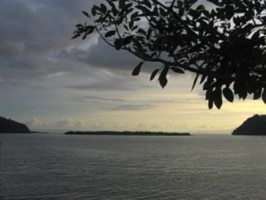
Twilight in Golfito. Source: Wikimedia Commons
Squatters of private property in Costa Rica, particularly those that trespass land owned by foreigners, are more than a just a nuisance. They are reminders of this country’s painful transition from an agricultural nation to an industrial and consumer society. Many foreign landowners have come to learn the hard way about Costa Rica’s murky agrarian court proceedings, and in some cases the squatting ends up being justified.
Such is the case of several hectares of prime land in Golfito, in the Southern Pacific coast of Costa Rica, near the border with Panama. Ston Forestal, a foreign-owned logging firm, is the legal proprietor of 40 hectares (almost 100 acres) of prime land in Golfito. The company has owned this land for nearly 20 years, and it has seen its fair share of precaristas (squatters) over the years. The latest invasion, which was reported by newspaper La Nacion on August 10th, looks like it might be the end of the line for the notorious history of Ston Forestal in Costa Rica.
The squatters arrived in early August with a list of about 300 families; many of them are low-income families that cannot afford the $200 monthly rent that is prevalent in the working-class neighborhoods of the Osa Peninsula and the southern region, which is transforming into a prime tourist and expat destination in Costa Rica -and is therefore getting very expensive to live in.
These squatters are organized by leaders who are very familiar with Ston Forestal and its checkered history in Costa Rica. They are empowered by the fact that Costa Rica is the last country in Latin America to feature an agrarian court tribunal that often sides with squatters under the following circumstances:
- The land is located in an agricultural zone, but has not been cultivated in more than a year.
- When absentee owners have let their lands go to blight and are not interested in farming or developing, they are rather waiting for the right opportunity to sell for maximum profit.
- The owner is obviously involved in a land grabbing scheme.
If anything, the seemingly-antiquated agrarian law in Costa Rica favors squatters since it directs landowners to begin negotiating with squatters after the property has been invaded for more than a year. Agrarian law also helps against land grabbing by corporations flush with cash that acquire for the sole purpose of speculation. It also promotes social justice in the sense that the law favors squatters in some circumstances, unlike in Panama, where the President Martinelli administration has enacted a law that sends squatters to jail.
In the case of Ston Forestal, however, the squatter invasion seems justified. Here’s why:
- Ston Forestal was once a subsidiary of Stone Container, a United States company that years ago merged into the Smurfit-Stone Container, a major manufacturer of paper and cardboard products that went bankrupt in 2009 and was later acquired by the Rock-Tenn corporation.
- In the early 1990s, Ston Forestal began planting beechwood (Gmelina arborea) in the southern region of Costa Rica. Aside from acquiring land in Golfito, the company also leased nearly 3,000 hectares of land from local farmers to plant trees for later logging.
- Years later, the global paper manufacturing industry started to suffer for many reasons -one of them being recycling. Ston Forestal allegedly failed to make lease payments to farmers in Costa Rica, and a class-action lawsuit was brought against the company to recover $26 million worth of delinquency.
- The $26 million liability above was never reported to investors, which is a clear violation of securities laws in the United States.
- Ston Forestal’s business downfall was so abrupt that they left piles of cut trees and large portions of logging areas that were never replanted. They also practiced monoculture, the planting of a single tree species, which puts ecosystems at risk. Environmental activists, backed by Greenpeace and San Francisco’s Rainforest Action Network, protested against this monoculture practice. This was all documented in the book “Guerreros del Golfo Dulce” by Dutch author Helena Van den Hombergh.
- From 1994 to 1999, Ston Forestal engaged in a greenwashing campaign masterfully conducted by Comunicacion Corporativa.
- Ston Forestal owes La Caja (Costa Rica’s treasured public health and system) about $89 million.
- Maximiliano Koberg Van Patten, corporate representative of Ston Forestal, through his representation of various enterprises in Costa Rica, owes La Caja about $200 million. What makes this debt even more egregious is that Koberg’s companies, according to volunteer investigator Roberto Mora Salazar, have withheld money -but never remitted- from employees’ salaries to ostensibly pay their obligation to La Caja. As a result, employees may be denied outpatient medical care -but they can never be denied emergency care.
In the past, Ston Forestal has been known to swiftly deal with squatters. When the company entered into the lease agreements they later reneged on, business representatives found families squatting on some of those farms, which had been abandoned by their owners for quite some time before Ston Forestal arrived. What happened next has been previously documented by Multinational Monitor:
“They paid the guards to get rid of us: they brought the rural guard to and from the site in trucks, gave them tractors, food and all the support they would need to kick us off the land. Stone told the rural guard to destroy our houses and our fields to ensure we would not come back.”
“Fifty-five rural guards came with guns. They bulldozed our farms, our crops, our trees to erase all that we had worked for. They came into our houses and dragged us outside – men, women, even little children. Then they burned everything that remained. Stone didn’t warn us they were coming because what they did is illegal. This is what foreign companies do.”
That is how Elias Villalobos Parjeles, a peasant farmer who squatted two years ago on an abandoned plot of Costa Rican land now leased to the Stone Container Corp. , describes the scene he witnessed as the National Guard [their translation for Fuerza Publica] forcibly evicted him and other squatter families, allegedly at the direction of Stone [Container], a Chicago-based pulp and paper company. The conflict between the farmers and Stone here in the heart of the Osa Peninsula, located on the southern cone of Costa Rica, just off the shores of Golfo Dulce at Punta Estrella, stems from Stone’s plans to build Central America’s largest chip mill in this rainforest jewel.”
The Costa Rica Star received reports from a self-described “concerned ex-pat resident of Golfito” about the August squatting of Ston Forestal’s land. This report described angry squatters setting the forest afire and threatening elderly neighbors while public officials assisted the invaders to settle in. Only the last part of that report can be substantiated; conservation workers from the Ministry of the Environment met with the squatters and instructed them to not settle near the many acres of protected mangrove and forest areas; they also told the squatting families about the areas that were at risk of flooding. The alleged fires and threats from squatters cannot be confirmed.
According to La Nacion, the legal representative of Ston Forestal has already filed an eviction course of action before the local court jurisdiction. The representative added that the land is not abandoned and is indeed farmed with small parcels of teak, palmito, plantain, and beechwood. This would help Ston Forestal evict the squatters, but it might not help their overall standing in Costa Rica. The land is a firm candidate for eminent domain proceedings due to its protected areas; plus, the numerous debts accumulated by the company could be attached as liens, thereby depriving Ston Forestal from possible profit.
In the end, should Ston Forestal lose the Golfito land to squatters, it would -in some way- serve as a just ending to its long history of corporate malfeasance in Costa Rica.



