


 SIGN UP FOR OUR
 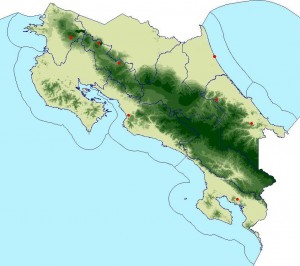 A promising find by a group of Yale University researchers studying the properties of fungi in the Amazon rainforest was once a subject investigated by a young Tica college student for her Bachelor thesis. The map to the right of this article shows the biodiversity areas in Costa Rica where Angelica Acuna Gonzalez indicated the presence of pestalotiopsis microspora.
Recent news regarding the amazing properties of the pestalotiopsis microspora mushroom underscore the importance of preserving the rainforests of the world. Pestalotiopsis microspora is a fungus that is found in great quantities in the Amazon rainforest, and it is believed that it can consume and digest polyurethane anaerobically. This means that, in theory, colonies of pestalotiopsis could happily live at the bottom of landfills while getting rid of that pesky plastic that never seems to go away.
Back in August of 2011, CNN reported about members of a Yale research team who discovered the plastic-eating properties of the pestalotiopsis fungus when a plastic Petri dish containing the tiny mushrooms mysteriously disappeared. Further research and a trip to the Amazon jungle in Ecuador confirmed that the fungi could be used in bioremediation projects, which means they could be put to work to eliminate polyurethane plastics. The formal study was published in the scientific journal Applied and Environmental Microbiology.
Polyurethane can be recycled by mechanical means; but, according to Plastics Today, a lot of it ends up in our landfills, where it simply refuses to disintegrate. Biodegradable plastic may seem like a panacea, but this research is bringing it closer to reality.
Angelica Acuna Gonzalez
When Angelica Acuna was studying Biotechnology Engineering at the Technology Institute of Costa Rica in 2009, she wrote a paper concerning the lignocellulolytic activity (51 page PDF in Spanish) of several microbes and spores. This was a partial fulfillment of the requirements she needed to obtain her Bachelor’s degree. The focus of her paper was the enzymatic activity of microorganisms and how they can be vital in the production of biofuels.
Angelica observed that pestalotiopsis, which can be found in the intestines of beetles and other members of the order Coleoptera around Costa Rica, exhibits the capacity to digest and degrade lignin and carboxymethyl cellulose. As ligning has been recognized as a biopolymer, and has even been developed as a biodegradable alternative to plastic for use in injection molding purposes, Angelica observed some of the same properties in pestalotiopsis that the Yale research team found. Alas, she did not leave pestalotiopsis unattended in a Petri dish long enough to find out that the fungus has a ravenous appetite for man-made polyurethane.
Two important lessons from the pestalotiopsis findings are: it pays to support the preservation efforts of the rainforests in Costa Rica and the rest of the Americas, and we should continue to support scientific discovery and study by young Ticos.



