


 SIGN UP FOR OUR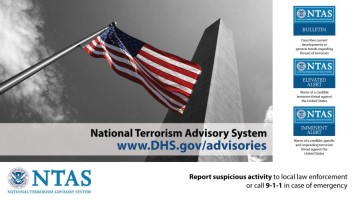
Source: US Homeland Security
Washington, Dec 16 (EFE).– U.S. Homeland Security Secretary Jeh Johnson on Wednesday added another terrorist alert level to the system created in 2011, which consists of two scales and never has been implemented due to the lack of credible threats.
At a press conference, Johnson presented the new intermediate level after announcing several days ago that there would be a change in the system due to the Dec. 2 attack in San Bernardino, California, in which 14 people were killed by a radicalized Muslim couple inspired by the Islamic State jihadist group.
“We are in a new phase in the global terrorist threat, which has implications on the homeland, particularly with the rise and use of terrorist groups of the Internet to inspire and recruit. We are concerned about the self-radicalized actors who could strike with little or no notice,” said Johnson in a bulletin.
In 2011, the Barack Obama administration replaced the color-coded alert system created by the administration of his predecessor, George W. Bush, in 2002 after the 9/11 attacks the year before.
The Bush-era system offered little information to the public about the security situation and made it difficult to reduce the alert level once it had been raised.
It was replaced by the National Terrorism Advisory System with just two levels – elevated and imminent – with the former indicating a credible threat limited in time and place and the latter indicating a specific threat of an attack in progress, a threat level that has never been triggered.
The NTAS system did not work properly within the current security environment, Johnson said, and the administration elected to change it to include situations and trends in general and less defined terrorist threats.
The San Bernardino attack, carried out by a U.S.-born Muslim man and his Pakistani wife, led the government to add a less precise intermediate level to this two-tier system, but one that is more practicable in terms of informing the public.
The DHS on Wednesday issued its first bulletin warning about the use of the internet by terrorist groups to inspire and recruit and about self-radicalized potential terrorists.
The bulletin says that although no specific and credible intelligence exists about a plan by terrorist organizations, the fact is that individuals have conducted or tried to carry out attacks in the United States this year.
Johnson said that after the San Bernardino massacre, the DHS has increased its activity level and has hiked protection efforts by government agencies and at public places and events.
In addition, he reiterated that the government continues to routinely deny entry into the country to people with possible terrorist links and is monitoring the social networks to detect activity by people who possibly have become radicalized. EFE



