


 SIGN UP FOR OUR
 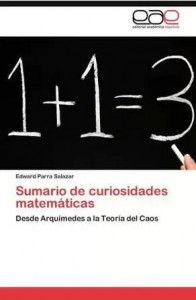 Math does not have to be a boring subject of study limited to memorizing formulas and solving equations. According to Professor Edward Parra Salazar of the University of Costa Rica (UCR) – Pacific Region, mathematics is a discipline filled with interesting tidbits that can entertain and even stimulate other areas of learning.
A new book by Professor Parra, entitled Sumario de curiosidades matemáticas: Desde Arquímides a la Teoría del Caos (Summary of Math Curiosities: From Archimedes to Chaos Theory) aims to debunk traditional approaches to math instruction by bringing out the potential that math has for generating curiosity and fostering logical thinking.
Professor Parra’s book is the culmination of a project he began in 2007, whereby he collected items of human interest to bring to math classes. In his book, the interesting facts surrounding math start with the odd-looking equation on the cover, “1 + 1 = 3.” It turns out that this equation was used by German mathematician Peter Gustav Lejeune Dirichlet in the 19th century when he sent a letter to his father-in-law with the to announce the birth of his son.
Another interesting fact that Professor Parra explains is how the Sine function got its name as the ratio of the length of the side opposite the given angle to the length of the hypotenuse of a right-angled triangle. When a Hindu mathematician studied Ptolemy circa 510, he took a word from the Alexandrian astronomer’s script, djiva. Over time, the vowels of the word were transposed until they formed the Arabic word djaid, which means female breast. European translators though it was odd, but went ahead and used the word “Seno” in Latin.
Academic leaders at UCR recommend the book to all math teachers in Costa Rica who are interested in planting the seed of curious endeavor among their students.
The New Axes of Math Education
UCR math researchers recently presented a proposal to the Ministry of Public Education (MEP) consisting of an overhaul of current math instruction in public institutions. The proposal was supported by opinions from academic corps in Chile, Mexico, Portugal, Spain, and the United States.
The idea is to make math seem more human by observing the five new axes of teaching: beliefs and facts, technologies, history, context, and problem solving. Each of these axis will be given equal focus, whereas in the past the concentration was on facts and problem solving.
Professor Parra is a strong proponent of humanizing math education. In his new book, he writes about the complexity of continued fractions as an example that: “the idea of math as an absolute and exact science is erroneous. In 300 BC, Euclides used these fractions implicitly, but it would be 1,800 years until they resurfaced again.” The proposed math curriculum in Costa Rica would look at why these fractions were not touched for centuries, and how they are important in numerical analysis and probability.



