


 SIGN UP FOR OUR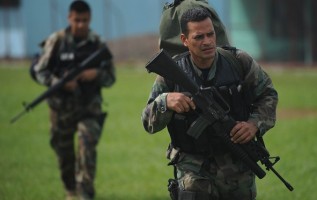
NIcaraguan forces. File photo
By Patricia Pernas for EFE
Governments in Central America, one of the world’s most violent regions, are expanding the role of their militaries in civilian affairs and increasing their weaponry, thus posing a threat to democracy, an expert told EFE.
“This strengthening of the armed forces does not come in response to national security problems,” Alberto Mora, the coordinator of the “State of the Region Report,” said in an interview, adding that “it implies risks for democratic stability.”
The 5th “State of the Region Report” points out that 80 percent of illicit drugs in transit from Central America to Mexico pass through Guatemala, that in El Salvador powerful gangs protect drug trafficking and that 79 percent of flights moving drugs from South America land in Honduras.
Between 2004 and 2014, Central American governments have spent $2.015 billion on purchases of weapons and military equipment from the United States on the grounds that the effort is necessary to combat drug trafficking and organized crime in the region.
Strong, well-equipped and professional armies are not a threat per se to democratic stability, Mora said, but in Central America the situation is peculiar.
In a context of weak court systems, rampant human rights violations, an almost endemic “fragile rule of law” and “feeble internal checks and balances,” strong armies become a danger for democracy.
With the exception of Costa Rica and Panama, which have no armies, the number of troops in the region has been growing.
Guatemala increased the size of its military by 57 percent in six years – from 14,193 troops in 2008 to 22,326 in 2014. El Salvador, the region’s third-largest country by population, upped the number of its armed forces personnel by 50 percent during the same period to 24,799, giving it the largest army in Central America. EFE
Guatemala City, Aug 24 (EFE)



