


 SIGN UP FOR OUR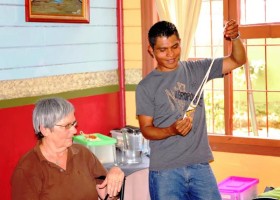
Enoc and Dr. Rosemary Sylvester
Bradley of ChocoPrisma. Photo: Bryan Fabio Herrera
By Carol Blair Vaughn
This interview was conducted on January 29th, 2016, at Bazookas Restaurant in Perez Zeledon, after a meeting of a club for English speakers (CCRC), at which Enoc Jimenez was the guest speaker. The Ngobe Indigenous straddle the Costa Rica – Panama border, and trace their lineage back to a time way before Christopher Columbus’ 4th voyage to the New World in 1502. The interview was conducted in Spanish.
CBV: Enoc, your talk was wonderful! Thanks so much for answering a few more questions for me. Where were you born?
EJ: I was born in Lajero de Nole Duima, Provincia de Chiriqui, Panama.
CBV: Where do you live now?
EJ: I live in Coto Brus, in the south of Costa Rica, near San Vito, in a small indigenous community, with my wife Dunia.
CBV: And how old are you?
EJ: I am 30-years old.
CBV: What do you do for a living?
EJ: Currently, I am picking coffee up north.
CBV: Picking coffee??? Enoc, you have a college degree from Universidad Nacional de Costa Rica UNA, for heaven’s sake!
EJ: Yes, but because I was born in Panama, I’m having to go through the same application process for Residency that you as an American went through. It’s slow, and complicated, and expensive. The border between Panama and Costa Rica is very arbitrary, and cuts right through indigenous lands, making it hard for many of us to work legally.
CBV: Tell me please, about your indigenous people. You seem to be spelling-challenged – I see your tribe spelled Ngobe and Ngabe. Which is it?
EJ: Either spelling is acceptable. The vowel sound is between an a and an o, kind of like an a in the English word “saw” or “gnaw”, so Spanish speakers often confuse the spelling.
CBV: I was always taught that your people were Guaymi. What happened there?
EJ: Guaymi is the name the Spaniards gave my people, and for that reason, my people don’t use it. It’s the equivalent of calling you a Gringa….
CBV: Ouch. What language do your people speak, and how many people speak it, more or less?
EJ: Our language is Ngobere. It is estimated that about 200,000 people in Panama and Costa Rica can speak Ngobere. It is an endangered language.
CBV: Tell me about those beautiful bright-colored dresses with geometric appliques that your women wear.
EJ: They are called enaguas. It is said that when Christian missionaries first arrived, our people were in loincloths and bare-breasted. The missionaries insisted on clothing – enaguas were the result of that.
CBV: They are beautiful, I think. What other crafts do the Ngobe make?
EJ: We make handmade bags from plant fibres called Kra. They are very time and labor intensive to make, and fewer and fewer women are continuing that tradition, unfortunately. We also make beaded bracelets and necklaces. The men weave hats – also labor intensive. Men and women make art from bark cloth, which is then hand painted and sewn with beads and seeds.
CBV: Now, Enoc, tell me about what I am most interested in – Chocolate!! I hear you are a master chocolatier. Tell me about that, please.
EJ: Cacao was a form of currency back in the day. If you had a few bags of cacao, you were well off.
Today, we are working to improve the quality of cacao and chocolate production in my area. We have new solar dryers to improve and speed up the drying process. We have formed a Women’s Collective of Cacao Producers, and are trying to get our chocolate designated Fair Trade so that we can export it.
CBV: Are you working with ChocoPrisma (a local chocolate factory located at Finca Juana in Pacuar)?
EJ: Yes, Rosemary Bradley, Director of ChocoPrisma, sources much of her cacao from the Ngobe people. She is currently raising money for us to buy special plastic sheeting to cover the solar dryers, which will enable farmers to do other things while the cacao is drying, for instance, tend their fields, or animals, or babies.
CBV: So what’s next for you, Enoc? How soon until you can use your education to teach legally in your community?
EJ: Well, one never knows with issues of immigration, right? I remain hopeful that my papers will come through soon. My wife was born in Costa Rica, and starts teaching this year. She teaches children with learning and physical disabilities. I’d like to begin teaching soon as well.
CBV: Will you come back to speak again someday? I heard some 43 people were turned away from your talk, because of space limitations.
EJ: I have been invited back for March, and I hope I can make it. Si Dios Quiere (God willing).
CBV: Teach me something in Ngobere, before we part ways, please.
EJ: Ja Tuaita. That means, See You!
CBV: Thanks, Enoc. Ka Jamen Tibta (Live in Peace).
About the Author
Carol Blair Vaughn holds a Master’s Degree in Performing Arts and is a retired college professor from Washington, D.C. She inherited her love for Latin America from her father, the former U.S. Ambassador to Colombia, Panama, and Director of the Peace Corps, Jack Vaughn. Carol writes for the Association of Residents of Costa Rica (ARCR) and for an English language club in the southern region of Costa Rica. In the past, Carol served as Editor in Chief of What’s on Tap magazine.



