


 SIGN UP FOR OUR
  Costa Rica is well-known around the world as a paradise for deep water fishing enthusiasts. Previous articles published by The Costa Rica Star touched on this subject, from planning a surfing-and-fishing vacation to Guanacaste for maximum enjoyment, to the joys of the Papagayo Peninsula. Other articles have revealed some hidden fishing spots like Manzanillo, and a lightly scientific discussion on the Costa Rica Thermal Convection Dome that makes our North Pacific coast a world-class fishing spot and a rich source of marine life.
Freshwater fishing in Costa Rica plays second fiddle to salt water fishing because the latter is part of our profitable tourism industry. This suits freshwater Tico fishermen just fine, since it gives them a sense of exclusiveness; of belonging to a group that gets more fish at less crowded spots. Everyone is, naturally, welcome and encouraged to take advantage of the fish that populates our countless lakes and rivers, but there are certain responsibilities and etiquette that must be observed.
Laws and Regulations
The Costa Rican Institute of Fishing and Aquaculture (INCOPESCA in Spanish) is the government agency in charge of enforcing the fishing laws in our country. Freshwater fishing in Costa Rica requires a sport fishing license that is issued by INCOPESCA at any of their 14 locations around the country. Tourists can also get these licenses at ICT offices, but if they have signed up for fishing with a tour operator then they are covered under that operator’s tourist license for fishing expeditions.
There are various types of fishing licenses for individual fishermen. For a Tico or foreign resident who wishes to fish from land in the continental waters of our country, the annual cost of the permit is 4,000 colones. For a Tico, foreign resident or tourist intent on fishing our continental waters from a vessel during high season (from January 1st to April 30th), a one-month permit will cost $15. One-year licenses for both shore-based and waterborne fishing are available for $30 for all individuals.
Fishing in our protected national parks is generally forbidden unless otherwise authorized. Enforcement of fishing licenses when fishing on freshwater, particularly from shore is often negligible; however, law enforcement and INCOPESCA officers have the right to stop unlicensed individuals. Engaging in behavior contrary to responsible fishing is guaranteed to attract attention from enforcement officers, and in this case unlicensed individuals could face confiscation of their equipment and catch. The governmental decree (PDF) on responsible fishing went into effect back in 2009, and it only applies to certain geographical fishing areas, but certain good standards of conduct and sustainability are applied across the country.
Fishing Clubs
There are a few fishing clubs in Costa Rica dedicated to both deep water and freshwater fishing. These are great organizations for newcomers looking for information and fishing partners. The Club Nacional de Pesca has been around for 50 years and it organizes legendary tournaments. For great discussion on freshwater fishing, the Foro Club Pesca is the best to discuss matters such as urban fishing in La Sabana and Laguna Fraijanes, tackles, responsible fishing, and keeping beer cold.
Recommended Catch: Freshwater Species and Habitats
Bobo Mullet – Pez Bobo – Joturus Pichardi
This herbivore fish swims in the rivers of our north Atlantic region. It’s a technical fish to catch; it is attracted to the Big O Cotton Cordell lures, numbers 3 and 4 green, yellow and red lures, and shrimp-like DT Dives from Rapala that must drag on the rocky river bottoms. If the lures don’t drag, these mullets aren’t interested. When they bite, they will swim with and against the current to challenge the angler.
Gaspar – Tropical Gar – Atractosteus Tropicus
This fish can be found in the slower-flowing waters of the north Atlantic region. It is a carnivore interested in small bait and the Rapala DT Dives and Countdown lures. It likes to swim near the surface, but its sharp teeth makes it a bit difficult to get a firm bite. Larger gaspar will give up easily.
Guapote Lagunero – Wolf Fish – Parachromis Dovii
This aggressive carnivore bottom feeder is like a Mexican boxer: gives a square fight and never gives up. It can be found near the shores of Lake Arenal and other lakes and rivers northeast towards the Caribbean. It is attracted to buzzbaits, feathered bucktail jigs, or anything that the Black Bass is attracted to.
Tepemechin – Mountain Mullet – Agonostomus Monticola
Another aggressive carnivore that swims in just about any river in Costa Rica. Enjoys small fish and shrimp baits, silver and golden spoons from #0 to #2. Puts up a strong, yet short-lived fight.
Sabalo Real – Atlantic Tarpon
Sabalos migrate to inland and brackish waters from the Atlantic in search of birds, turtles, reptiles, fish, and just about anything they can find. This is a prize catch for a freshwater fisherman who can get a Sabalo to bite on multiple fish lures or Rapala Clackin Raps. A similar species is the Robalo, a Centropomus-like snook, which enjoys the Rattlin Rapala and will fight in spectacular fashion all over the river.
Trucha Arcoiris – Rainbow Trout – Oncorhynchus mykiss
This high-altitude omnivore is another prize catch. It is an exotic species that thrives in just a few bodies of water near the Cerro de la Muerte. It does not disappoint when it comes to reeling in, and is attracted to insect-like spoons from #0 to #2 of the shiny variety.
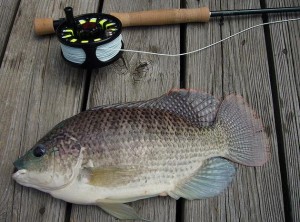
Tilapia – Oreochromis Niloticus
This is an invasive species that deserves to be caught and fileted. Tilapias are everywhere, they are mostly herbivores but will eat anything when hungry, and they are delicious. #1 and #2 shiny spoons and small fish are sufficient, although Tilapias can be picky eaters and hard to bait sometimes.
Invasive species can cause serious problems. A few years ago, Diario Extra reported on a 20 kg Piranha caught in La Sabana, just weeks after the ducks had gone missing. Being an invasive species, no one will mind if you catch and keep a few Tilapias to marinate in lime juice, olive oil, cilantro, and minced garlic. Grilled, baked or breaded and deep-fried; Tilapia never disappoints.



