


 SIGN UP FOR OUR
 Bangkok, Oct 27 — Thai firms are preparing to export insects for human consumption to the European Union, which organized a conference in Bangkok this week to explain new regulations covering this category of food products.
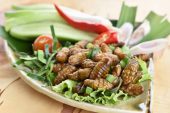
Fried silkworm salad, Facebook.
Thailand is one the world’s largest consumers of insects and has some 20,000 insect farms. Products made from these invertebrates are also sold in processed forms such as fried crickets or cricket flour.
New European legislation will allow the sale of insects for human consumption from 2018 onwards; although countries such as Belgium, Holland and Denmark have already independently approved such sales.
According to European law, the European Food Safety Authority will evaluate every new kind of food, including insects, before the EU approves their commercialization, a process that can take months.
Some of the Thai products that could reach the European supermarkets are Bugsolutely pasta (with 20 percent cricket flour) and Hi-So’s packaged fried silkworms that are consumed in Thailand, Myanmar, Cambodia and Laos.
“From January 2018 onwards, the regulation on new food products in the EU will be in effect. We hope some of the insects will reach the European market the same year,” Bangkok-based Bugsolutely’s co-founder Massimo Reverberi told EFE.
“Insects like crickets will easily get the green light because they have been consumed in many countries for many years, while for others like scorpions it will be more difficult,” he explained.
Reverberi believes Asia leads the insect production market for human consumption, although there are emerging initiatives from countries such as Mexico and Brazil too.
The Food and Agriculture Organisation (FAO) of the United Nations has for years recommended the consumption of insects such as crickets and grasshoppers owing to their high protein, vitamin and mineral content.
Experts consider insects a more sustainable solution for feeding the world’s growing population, which is forecast to reach nine billion people in 2050.
Currently, some 112 countries in Asia, Europe, Africa, the Americas and Oceania take part in entomophagy, or the consumption of insects, extending to a variety of 1,500 species, according to the FAO.
Insects, however, continue to remain expensive as compared to other meat such as chicken. However, this could reverse with large scale production. / Gaspar Ruiz-Canela for EFE



