


 SIGN UP FOR OUR
To read previous entries in this series, click here for Part One and here for Part Two.
On a Sunday afternoon three weeks ago, I was looking forward to watching the national derby match between Deportivo Saprissa and my favorite football club, Liga Deportiva Alajuelense. Instead, I ended up listening to the match on the FM radio application of my ancient Nokia mobile phone because the main switch that controls the flow of electricity to my house was destroyed by an act of vandalism, which law enforcement officers and investigators believe may be connected with an ongoing dispute I’ve had with the owner of the property I rent.
Author’s Note: I am heeding advice from two attorneys who have recommended that this report should include as little personally identifying information as possible.
This is the third article in a series that explains why I may be evicted in Costa Rica. If you wish to get more background on this situation, which includes kicked doors, trespassing, shouting matches in public, dead tomato vines, and unpleasant landlord-tenant relationships, please click here for Part 1. If you would like to learn about Public Laws 7527 and 9160, which deal with leasing and tenancy, click here for Part 2, where you can also review the legal opinions of various attorneys.
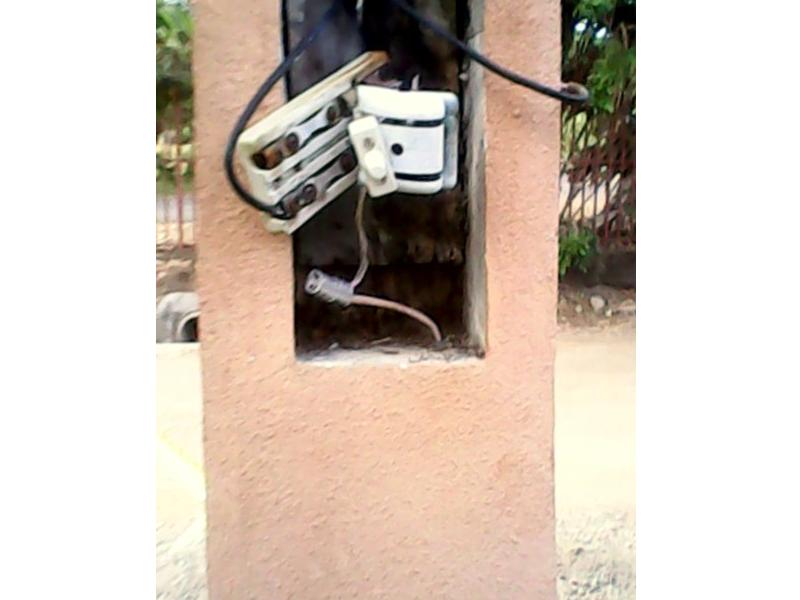
The picture that accompanies this article shows the state of the main electrical switch, which sits just outside the front yard of my house, after it was vandalized by an unknown male on the aforementioned Sunday afternoon. At the time of the incident, I was in the backyard hanging some laundry out to the dry while my elderly mother was in the kitchen preparing coffee.
My mother witnessed a middle-aged man approach the outdoor switch to turn off the flow of electricity; at that time, he took a tool out of his pocket and used it to pry off the device, breaking a few cables and sending sparks flying as an improper contact was created by the vandalism. By the time my mother got my attention, the man had already taken off running down the street, but not before he knelt down on the sidewalk to cut off the water supply next to the utility meter. We were left without electricity and water; I went outside and saw the man disappear into a nearby coffee farm, too far to catch on foot and I did not even have shoes on.
I turned the water back on and approached the damaged switch. Sparks were crackling and flying out of two exposed cables making contact; the other cables were broken and the plastic cover of the switch was on the grass. The sparks worried me because the concrete column housing the switch and the electric meter faces the sidewalk and people were walking by as they came out of Sunday mass. With insulated pliers, I separated the cables to stop the sparks, which were falling on dry grass.
Later on that Sunday afternoon, officers from Fuerza Pública and field workers from ICE (the electric utility monopoly of Costa Rica) would arrive at my house. By Tuesday, I had agents from the local OIJ field office talking to my mother and contacting the property owner to question her about the incident.
What May Have Prompted the Incident
A few days before the incident, I exchanged a few terse words with my landlady, who is under the impression that the leasing and tenancy laws do not apply to her because she comes from a family of rich landowners who own several properties in a few cantons of the Alajuela province. As explained in the first two parts of this series, the landlady heretofore known as Mrs. B. wanted me to leave her property in mid January; back then, she said she wanted me out in two days and refused to accept a rent payment. I hired an attorney to write a letter reminding her that Public Law 7527 states that landlords who wish to break a rental contract in Costa Rica must notify tenants in writing three months in advance or else start the eviction process in court. Mrs. B. received the letter a few days after she told me I had to leave, and she was livid. Prior to getting that letter, she came by the house while I was at law firm and told my mother that she could have us out of the house in a couple of days thanks to her connections with attorneys and Fuerza Pública; she also mentioned that her husband was planning on coming to the house to start taking furniture out on the street.
In part two of this series, I wrote about my last telephone contact with the landlady late last month:
“Mrs. B, my mom said you visited the house. Law 7527 states that you are allowed to visit once per month. You will not enter again in January. If you attempt to enter or remove my personal property, like you warned my mother earlier today, I will call Fuerza Pública. If your husband attempts to enter the house you own, and that I currently occupy, I will physically remove him from the premises, with force. You may come by on Saturday afternoon, but you will not be allowed to enter. Don’t expect to pick up the keys; I have a copy of a letter from my attorney that I think you should read… that is what you can pick up at this time. Not keys nor rent money; just that letter, of which you will receive an original via EMS on Monday.”
Mrs. B. eventually came by to pick up the letter while I was at work. She initially dismissed the letter and said I wrote it and thus had no validity; I guess she failed to see the big notary stamp and the attorney’s signature at the bottom of the page. It so happens that the attorney in question is Mrs. B.’s cousin; I later found out that she rushed to the law firm and berated her relative for providing me with legal services. Eventually, Mrs. B. somewhat came to her senses by producing a letter written by another notary who confirmed receipt of my letter and acknowledge that I indeed have three months to move out; however, Mrs. B. now demanded the rent payment she had refused a week earlier and said she planned to file for eviction.
I told Mrs. B. that I was withholding the payment under legal advice. It was her cousin who proposed the strategy of keeping the money available in case of an eviction notice or in case she ordered ICE to suspend electrical service. The strategy consists of making the rent payment in concession to the municipality instead of making it directly to the landlord; doing this would create a receipt that can be presented in court or given to ICE in case she lies about the dwelling being unoccupied.
Landlords in Costa Rica, pay attention: If Mrs. B. wanted to suspend electrical service, she would not only have to lie but also pay all amounts due to date as well as a disconnection; in my town, ICE runs 45 days behind in terms of billing, and thus this would cost her approximately $100. There’s also Article 31 of the leasing and tenancy law, which prohibits landlords from suppressing or otherwise reducing utilities. If she tricks ICE into disconnecting, I can reconnect by showing a copy of the contract and the rent receipt from the municipality. Violation of Article 31 may trigger Article 28, which essentially allows tenants to prevail in eviction court by showing ill intent on the part of landlords; this may leave the judge open to entering an order to reimburse the tenant with partial rent payments.
Mrs. B. called me to ask if I had received the letter. I confirmed and told her that I understood her position and that I expected to receive notification from the court to attend the eviction hearing, to which she replied that the case had already been decided and that Fuerza Pública was on its way to carry out the “desalojo administrativo” (forcible removal), but that she would call off the officers if I gave her the rent payment. For the record, Mrs. B. is known to make such empty threats, and she has made a few more via text messages, which OIJ agents have reviewed.
When I explained to Mrs. B. that her cousin had advised me to withhold the rent payment as part of a legal strategy, she screamed profanely and hung up the phone. A few days later, my electrical and water services were interrupted by means of vandalism.
Repairing the Damages
When I called ICE to report the incident, I was told that repairs due to vandalism require a police statement, and thus I called the local Fuerza Pública station. I was informed that they were short on staff due to officers responding to a massive bar brawl that left a few people injured. Apparently, the bar was packed with Saprissa and Alajuelense fans who wanted to catch the derby on TV; alas, a few of them had too much to drink before the match and ended up in the hospital.
The officers arrived about three hours later; I was concerned about the food in the refrigerator since the afternoon temperatures were close to 33 Celsius. The officers took my statement and left me with an Acta de Observación Policial, which is basically a document that describes the incident and the scene. One of the officers put gloves on and manipulated a couple of exposed cables to bend them inward since they were live and a danger to the public.
Once I had the police document on hand, I called ICE to let them know. By the time the field technicians arrived, I had given up hope of catching the derby on television and was listening to the radio broadcast on my mobile phone. The technicians first believed that a crackhead had stolen a breaker box to sell as scrap metal; however, this was an old fashioned ceramic switch. Once I told them about my tribulations with Mrs. B. and that the vandal had also cut the water, the technicians commented on how dumb and petty it is to damage your own property. One of them said:
“The guy who did this is really lucky he did not get himself electrocuted. I know Mrs. B. and her family, never liked them much but did not know they would stoop so low. She will get a bill from ICE for this repair in a few weeks, because this is her property, not yours or ours. And this damn ceramic switch is so old, what a cheapskate!”
On Monday afternoon, I followed the advice of the Fuerza Pública officers and went to the courthouse complex in Grecia to speak to judicial officials about how to deal with this situation. I spoke to a prosecutor who was interested in the case because of my mother:
“Your mother is older than 65; she is a Golden Citizen of Costa Rica who deserves protection. Cutting off services to the elderly is a crime. Since we don’t know the identity of the vandal, we should have OIJ agents investigate. You also have plenty of reasons to initiate a civil complaint against the property owner; think about that after talking to OIJ.”
I went to the OIJ office and was interviewed by an intake clerk who took my statement and made copies of the image in this article as well as of the document prepared by Fuerza Pública. He said that agents would be at my house the next morning and suggested to tape the OIJ intake report and the Fuerza Pública statement to the window so that the agents could identify the house.
The two agents arrived around 9:00 am; they were sharp and inquisitive. They asked lots of questions and confirmed my mother’s age by looking at her cédula. They looked at legal documents such as the lease contract and the attorney letters. I showed them the nasty text messages sent by Mrs. B., whom they know about because of her father. I explained many of the highlights that you can read in parts one and two of this series. One of the agents then said:
“From what you are telling me and from I can see, this is not random vandalism. Whoever did this came straight here with a mission. Why destroy only your switch and then cut off your water? There are four homes with identical utility columns next to yours, why not hit those as well? I need your landlady’s phone number and home address; I want to question her.”
“In the unlikely event that Mrs. B. gives herself up, what happens next?”
“In that case, I would take my file straight to the prosecutor, and she may call you as a witness. Your mother is an elderly woman and must be protected. We can’t have people going around cutting off utilities to Golden Citizens. If your landlady wants you out, she could file for eviction. I don’t see that here.”
After the agents’ visit, I left the OIJ and Fuerza Pública documents taped to the window because I noticed that passerby seemed to pay attention to them. I printed out a sign warning about video surveillance equipment, even though none was actually installed. The idea was to dissuade Mrs. B. from sending out more henchmen, but an interesting thing happened.
A “Secret” Surveillance Camera
I did not follow up with OIJ as to their investigation since I figured that Mrs. B. wouldn’t be so dumb as to give herself up. A couple of days later, my mother saw Mrs. B. and her husband cautiously approach the window to look at the documents and around the property; they were even startled by a stray dog turning a corner. I did not hear from her at all for about a week; this was a welcome change from the nasty phone calls and the silly threats via text message. Then she started sending out her husband on weekday afternoons to pretend he was working on the yard. Finally, she sent me a message ordering me to take down the documents and the cameras because, in her words, the law says I cannot install security devices or post anything on windows without her permission.
I replied that the documents and “camera” were there for my mother’s protection while I was at work because of vandalism in the area. She texted back and said that she knew about it because an OIJ agent contacted her. She then sent a string of text messages with irrational explanations as to why I should take down the signs; I eventually wrote back to say I would remove them after getting an update from OIJ.
I called the regional OIJ office and was able to talk to one of the agents who came to my house. I told him about Mrs. B.’s reactions to the documents and the security camera sign I posted, and he explained:
“I am not attorney but I can tell you that you have every right to leave those documents posted. They are no different than Christmas lights in December. The sign was clever, but you should look into installing a real security system. Look, I called the lady and did not get a good vibe from her; what you are telling me now makes her seem even more suspicious, so I will make a note in my case file. She does not seem like you much, but after seven years and more than $24,000 in rent that you have paid, she should not be doing these things. We have laws in Costa Rica.”
I took down the documents and sign down after a few more text messages from Mrs. B. and after learning from the neighborhood buzz that many people were talking about the incident and wondering how much damage her reputation as a landlady has taken due to the incident. I let her know via SMS that I would take down the papers, but that there was no way for her to know if I took down the camera since it is “concealed.” She has not replied. The papers and the sign actually made the house feel safer; now that they are gone, bad dudes and bad hombres could show up without warning. Sad!
In the end, only a few items were spoiled during the power outage and the derby match wrapped up with yet another loss for Alajuelense, so I did not miss much; however, I have come to truly appreciate the work of the professionals from Fuerza Pública, ICE, and OIJ. It is important to note that the ICE technicians restored power on a Sunday afternoon, that the police officers arrived after dealing with a major brawl, and that OIJ took interest in a case that may have involved minor damages, but that also affected my elderly mother. These are all public servants in Costa Rica, and they all showed dedication and a desire to help.
For the next installment in this series, I will describe the process of finding a new place and will discuss the current rental market in Costa Rica.



