


 SIGN UP FOR OUR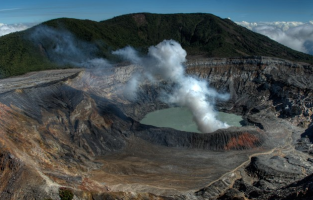
Poas Volcano crater in Costa Rica
Earth scientists at the National Seismology Network (Spanish initials: RSN) and at the National Observatory on Seismology and Volcanology (Spanish acronym: OVSICORI) are being kept on their toes by the activity of two colossi in Costa Rica.
Readers of The Costa Rica Star are likely to be familiar with the hyperactive state of the Turrialba volcano, located in the province of Cartago, which has been in a constant state of flux for about two years. Now in the province of Alajuela, the Poas volcano seems to have awakened.
Over the weekend, a powerful eruption at the Turrialba volcano sent ash and non-magmatic debris flying as high as two kilometers in the air. Geologists on duty at the research station located near the crater of the Irazu volcano (located across the Turrialba and separated by a valley) observed eruptions on Thursday, Friday and Saturday.
Volcanic ash clouds and the unpleasant smell of sulfur in the morning affected the communities of Coronado, Guadalupe and Moravia, all part of the Greater San Jose Metropolitan Area of Costa Rica (Spanish acronym: GAM).
The Poas volcano has been subject to phreatic (ground water) eruptions, which are unpredictable and have in the past splashed tourists standing on the observation platform near the crater. These eruptions at the Poas volcano, located on the edge of the GAM, tend to be spectacular since the sulfur pools at the bottom of the crater lake build up pressure until they reach temperatures as high as 200 degrees Celsius, at which point they eject a combination of toxic water and volcanic debris up in the air.
Currently, the Turrialba Volcano National Park is under a Yellow Alert and closed to visitors. The Poas is still open for tourists, but visitors may face evacuations when the crater lake starts bubbling.



