


 SIGN UP FOR OUR
  Digital community newspaper La Fragua, along with various other news sources, recently reported on the planned donation of more than 19,000 computers by the government to students at public schools nationwide. This is part of a greater initiative that was first brought to light a few months ago by the Omar Dengo Foundation. The foundation’s namesake was an intellectual who was one of the first to denounce the futility of a militaristic society, and who also argued that education and the study of efficient pedagogy had an important place in Costa Rica. The name of the governmental and academic initiative to bring computers to Tico students is called Acuerdo Social Digital (ASD), an effort by the Ministry of Education (Spanish acronym: MEP) to bridge the gap caused by the digital divide.
At the announcement of the initial phase of the ASD, President Laura Chinchilla and Minister of Education Leonardo Garnier traveled to a tiny school in Siquirres, in the Limon province. A young girl named Fransini was the first recipient of a laptop, given to her directly by our President. The first phase of ASD will benefit students in 64 rural high schools and 282 public grade schools. The goal is to have reached 1,505 high schools and 1,222 elementary schools located in remote rural areas by 2015. The launch of the project was viewed at other schools where students participated on a web conference on their new shiny laptops.
Details released by the MEP indicate that the ASD initiative will cost Tico taxpayers about $16 million, and that students will be encouraged to take the laptops home. Minister Garnier underscored the importance of bringing the world of mobile technologies to students who can perform a number of learning activities on the laptops, from doing school work and playing educational games to online collaboration with other students, and even creating their own digital media publications like The Costa Rica Star.
Although the MEP did not release the technical specifications of the ASD laptops, a close look at pictures of the event reveal that they are Hewlett Packard notebooks that bear the Microsoft Windows sticker. The laptops look like the new ultra-thin and lightweight HP Pavillion notebooks that have been lauded for their performance and ultra-portability. What is known about the ASD initiative is that, at a cost of $16 million, the government is spending more than $800 per laptop. Here it may be worth to mention that HP is a major employer in Costa Rica.
The Quiros Tanzi Foundation and the One Laptop Per Child project
Just weeks before the ASD initiative described above was announced to the public, another significant initiative sponsored by the MEP donated 1,500 laptops to children in 15 public schools. This initiative, called Proyecto Conectandonos (Let’s Get Connected), also aims to bridge the gap caused by the digital divide and empower young students to discover the digital world. This initiative is a public-private partnership that’s being coordinated by the non-profit Quiros Tanzi (QT) Foundation.
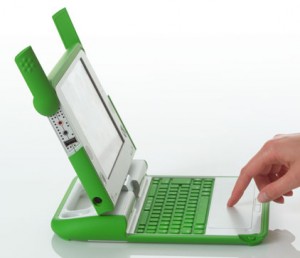
The QT Foundation aims to place 25,000 computers in the hands of young Tico students over the next two years, but the hardware focus is radically different from the HP laptops that the ASD initiative is dealing with. The QT Foundation is concentrating on the XO, the revolutionary portable computer that is synonymous with the One Laptop per Child (OLPC) project. The OLPC was once referred to as the $100 laptop project, an initiative envisioned and by American scientist Nicholas Negroponte in the year 2000.
OLPC is an ambitious worldwide project that seeks to narrow the digital divide gap on a global basis. Of all the countries where OLPC has been implemented, Uruguay is a shining example of the sheer societal benefits that can be realized when young students and their families are digitally engaged and empowered. Miguel Brechner Frey, a communications engineer who spearheaded OLPC in his native Uruguay, was responsible for coordinating a program that not only delivered nearly 500,000 XO laptops to students and teachers, but also guaranteed free Internet access for educational purposes.
Mr. Brechner Frey was a presenter at the recent TEDx Pura Vida conference in San Jose, and he underscored the need to reach Costa Rica’s rural communities with technology. He made allusion to the possibilities of using human bandwidth and sneakernets with low-cost solutions such as storing information on USB drives and using people as data couriers. A similar process was discussed by The Costa Rica Star in a previous article that parallels the fiction of William Gibson’s novel Spook Country with reality.
The immediate effects of OLPC in Uruguay have been discussed on CNN: school dropout rates have decreased, while attendance rates have increased. There have also been reports of important changes in family life, whereby children are taking their XO laptops home and teaching their parents how to read and write with software that promotes literacy. Adults who are benefited by the XO laptops are also engaged in online social networking and even finding jobs. Children are becoming teachers to their parents, and the social fabric of communities in Uruguay is changing. All that for a considerably low cost of investment, not quite the $100 originally envisioned, but close enough as we’ll see below.
Transparency in Reporting
Aside from the launch ceremony of the ASD initiative, neither the MEP or the Omar Dengo Foundation have provided too much information. We know about the projected cost, and we can infer information on the hardware by looking at the press photos, but that’s about it. The QT Foundation and its private partners, on the other hand, have been very transparent about their work. Case in point is the XO blog maintained by the QT Foundation, in which we can find the hardware specs of the XO:
-1GHZ VIA low-energy consumption processor
-1GB DDR2 SD RAM
-4 GB NAND Flash drive with an internal microSD card with an expansion slot
-LCD touch screen
-Wi-Fi connectivity and networking
-USB ports, microphone, camera
The XO is truly versatile, as it can double as a tablet, and is also very rugged. It looks like a Fisher Price toy, and in fact it is impact and spill-proof. There’s no doubt that the XO is for children, from the Sugar operating system (based on the Linux kernel, like Android) to the whimsical GNOME desktop. Each XO comes preloaded with software applications designed specifically for learning and networking.
Thanks to Banco Lafise, one of the private partners involved in the project, we know that the real cost of each XO is $210. Banco Lafise has pledged 500 XOs to the effort, and to that extent they know that they have to come up with over $100K. The bank already has a plan: It started with the auction of a painting by Tico artist Moises Gorn. That netted Banco Lafise $3,000. Then, according to their own documentation, they realized $6,000 from the sponsorship of the Carrera Interbancaria, an athletic event in which 500 runners participated. The rest of the money is expected to come from donations among the bank’s account holders and partners. In the event Banco Lafise does not collect the $100K+ they need to donate 500 XOs, they may have to put up the rest from out-of-pocket funds.
The amount of transparency provided by the QT Foundation and it partners is in stark contrast to the information release by the MEP thus far, although this may be due to the fact that the ASD initiative is just getting started. In covering the launch event for the ASD program, Diario Extra indicated that the ASD hardware differs from the “bare-bones $100 offerings seen in other countries”, and that Costa Rica’s plan is different in the sense that the HP laptops are powerful and expected to be with each student until graduation from high school.
Regardless of whether MEP and the Omar Dengo foundation will release more information about ASD, as the QT Foundation and Banco Lafise have done so far, remains to be seen. It is of interest to Tico taxpayers, but in the end it is more important that the commitments are kept. As long as the computers are reaching the intended students and their families, as they have done in Uruguay, the efforts of the government and the private partners are to be applauded.



