


 SIGN UP FOR OUR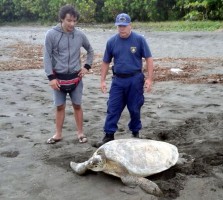
Source: MSP Costa Rica
This past Saturday, poachers plying their loathsome trade in the Caribbean region of Costa Rica were about to butcher an adult female Chelonia mydas (green sea turtle) when officers from the National Coast Guard Service and the local Fuerza Publica detachment stepped in to prevent what would have been a violent demise for the aquatic reptile.
According to a Facebook update posted on the official Timeline of the Ministry of Public Safety (Spanish initials: MSP), the incident took place this past weekend as part of joint foot patrols carried out by members of the Coast Guard Station Pacuare and Fuerza Publica officers. The patrol took the officers to the sector near the mouth of the Pacuare River. As the officers came close to a jungle trail known to be used by poachers, they heard rustling sounds of vegetation followed by hurried footsteps.
As the officers pinpointed the location of the commotion, they found an adult green sea turtle that had been crudely left belly up and lying on its carapace. The female seemed to be carrying eggs, and her flippers had been tied to prevent her escape. The officers untied the sea turtle and carried her to the nearest beach, whereupon she headed towards the ocean as soon as her flippers touched the wet sand.
Mauricio Vargas, a biologist who works for the environmental conservation section of the Coast Guard in Limon, explained that a green sea turtle may lay between 110 and 120 eggs upon each arrival, which could happen up to six times in a nesting season. Although green sea turtles could potentially lay 600 eggs during a single nesting season, only between 60 and 80 percent of all eggs will hatch. This means that the actions of the combined foot patrol in Pacuare may have saved the future lives of about 400 baby sea turtles.
The National Coast Guard Service has been augmenting its protection of coastal communities by increasing the frequency of foot patrols along the beaches and estuaries of Costa Rica.



