


 SIGN UP FOR OUR
PORT OF SPAIN, Trinidad — Child marriage will likely soon be illegal in Trinidad and Tobago. The Miscellaneous Provisions Marriage Bill, which Trinidad and Tobago’s attorney general presented in the country’s senate nearly ten days ago, has passed — even with four opposition senators (including a woman) and one independent choosing to abstain. All that remains, as the bill proceeds to the House of Representatives, is the support of a simple majority to make it into law.
However, Sat Maharaj, the secretary general of the Sanatan Dharma Maha Sabha, the country’s most high-profile Hindu organization, has threatened legal action, should the amendments to the Marriage Act be passed.
The lone woman who abstained from the senate vote, Khadijah Ameen, maintained that religious perspectives that were expressed in parliament “through two temporary appointments in a representative of the Muslim faith and a representative of the Hindu faith” had merit, saying, “Those views have been criticized but they are real, they are part of our multicultural society and we must give an air to those views.”
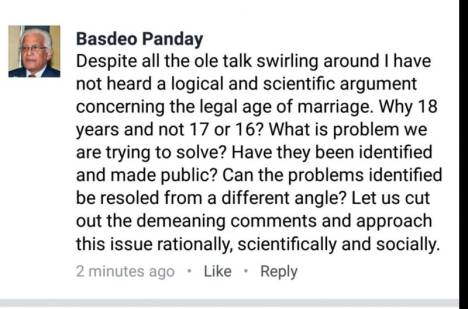
Meanwhile, on social media, larger issues were discussed such as by Facebook user Skye Hernandez, who mused: “People, don’t think it’s only those who are still advocating to keep child marriage on the books that have a problem, eh. Walk in town with a 10-year-old girl and notice how big men look at her. It is disgusting and terrifying. The whole ‘after 12 is lunch’ culture is not only upheld by outdated religious ‘laws’ and their advocates. It’s everywhere in this society — open season on women and girls.”
“After 12 is lunch” is an idiom meaning that once a girl is older than 12, she is no longer off limits sexually.
Interestingly, the position of The Hindu Women’s Organization of Trinidad and Tobago on this issue is at loggerheads with the stance of some religious leaders. The group “[reiterated] its call for the age of 18 to be established as the legal age of consent to marry with provisions for 16-18 year olds under strict checks and balances,” adding:
“In so doing, we seek to correct the misleading statement made by temporary Senator Basdeo Seetahal in the Senate debate of January 11, 2017.
“We have not rescinded our position as he claimed.
“Our position, articulated since 2012 in the resolution coming out of the Marriage Act Public Discussions held by the organization that year, is that the Marriage Acts should be updated to reflect the age of consent for sexual relations.”
In a letter to the editor submitted to the popular website Wired868, Alana Abdool wondered whether “the hyper-sexualized culture of youths” was linked to the furore surrounding child marriage:
“Lust, love and sex are all part of a complex dynamic of the fight for power between the sexes. It is unfortunate that marriage is deeply interwoven into this web and usually suffers the fatal blow…
“The fight for marriage has been age old. The products of the war has seen the creation of a deeply rooted culture of sexism, feminism, misogynism and objectification…
“The current debate on child marriages has been a morose, crass exchange of rebuttals over the right to grant the child the opportunity to marry or not marry along a subjective morally defined age range—vis a vis a grant of the right to let them know when to lust, love and have sex using foolproof, technically defined, sexualized parameters.
“And by the grant of a right to marry, I mean the conditions for a sex license. And by conditions I mean age. And by sex license I mean the Marriage Act…
“We must be wary that we do not objectify the discussion of the readiness of children for marriage and in so doing, weaken one of the greatest foundation blocks of a society.
“There is infinitely more to this debate than the butchering currently being rendered in parliament. There is also infinitely more hypocrisies in what is not being addressed than what is.”
The bill is widely expected to pass in the lower house of parliament. If it does, it would then need to be assented to by the country’s president in order to become law.
– Reprinted from Global Voices



