


 SIGN UP FOR OUR
 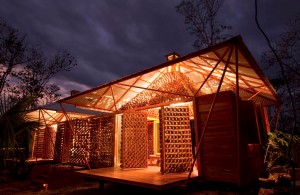 One of the most awaited presenters at the upcoming 2012 International Design Festival (Spanish acronym: FID) is Benjamin Garcia Saxe, a London-based Tico who was also a presenter at the recent TEDx Pura Vida conference. Benjamin is an acclaimed architect and visual designer who has worked in several world-class projects, including the design of Three World Trade Center, one of the new skyscrapers that will form part of the future WTC complex in New York City. Among Benjamin’s amazing portfolio, two project stand out: the Forest for a Moon Dazzler bamboo residence in the forest, and the Containers of Hope residence located 20 minutes outside of San Jose.
Forest for a Moon Dazzler was recognized as home design of the year in the 2010 World Architecture Festival in Barcelona. This handsome bamboo house was lovingly designed by Benjamin for his mother and brother. Benjamin’s background story of Forest for a Moon Dazzler is certainly touching. In a recent blog post from Ligia Olvera, a life coach and corporate trainer who also writes for El Financiero, the story of Benjamin’s and his mother’s home is revealed:
“Mom and I never had a place we could call home. We were always seeing each other out on the streets and dreamed of having a place where could be together. She stayed in the city just so she could find solace in being close to me, but I never stopped dreaming about a place where she could find happiness.
Emotionally broken by city life, she took to the forest looking for her home. With her bare hands she built a house made of tree branches and salvaged materials. It was there that she found the moon and the sun dazzling her every day. Intuitively, my mom placed her bed in a spot where she could directly look at the moon and somehow shorten the distance between us.”
Before and After
Benjamin’s drastic revision of her mom’s home in the forest can be appreciated in the before and after photos in Ligia Olvera’s blog. Even more pictures can be seen appreciated in this Mexican architecture online portal. Benjamin’s smart design is clearly evident, from the conical dome that doubles as a skylight and climate control device to the private living spaces and functional rooms.
What’s really amazing about the Forest for a Moon Dazzler in Guanacaste is not so much that it is made out of bamboo; it is rather Benjamin’s vision as an architect that transformed his mother’s dreams into an award-winning reality. The elegant home was planned on a shoestring budget. The two main bamboo modules cost $20,000 each, and Benjamin believes that with greater planning and efficiency such bamboo structures can be ideal in low-income housing projects.
Containers of Hope
After Forest for a Moon Dazzler, Benjamin once again made a splash in 2011 with another $40,000 home, only this time was not made out of bamboos. Two discarded shipping containers make up the living spaces of Benjamin’s vision. These two containers were transformed into a smartly-designed spacious home that features natural lighting and a climate control system that operates without external power. Detailed photos of the finished project can be seen at the Costa Rica Architects blog.
The Containers of Hope project is hardly the only residential solution made out of intermodal containers, also known as conex boxes. These multipurpose shipping containers are made from reusable steel, yet when they can no longer be used for shipping they are often irresponsibly disposed of. Finding ecologically and socially responsible uses for these boxes is the right thing to do. Readers of The Costa Rica Star who are interested in these types of housing solutions can contact Benjamin directly.
It is important to note that both housing projects described above were designed and built in the midst of the global financial crisis. Benjamin is part of the young school of thought in Costa Rica that is firmly identified with sustainability, and to that extent both Containers of Hope and Forest for a Moon Dazzler succeed in being low-cost solutions that take advantage of renewable resources (his mom’s bamboo home), and recycled and re-purposed products (Containers of Hope).



