


 SIGN UP FOR OUR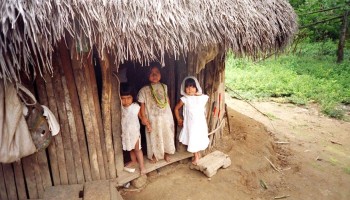
Wikimedia Commons
Leticia, Colombia, Nov 30 (EFE).– While world leaders seek to negotiate an agreement in Paris to deal with the threat posed by global warming, an Indian tribe living under the Amazon rainforest’s vast green canopy remains skeptical about the COP21 summit in the French capital, saying that the damage caused to the planet cannot be reversed.
The chief of the Huitoto people, Hitoma Safiama, sat inside his “maloka,” or hut, in the middle of the forest and said that COP21 would have “pure words” and “lots in theory, and nothing in practice.”
“They are meeting in France, but what are they going to do? Against nature, nothing can be done,” the chief and shaman of the Huitoto people told EFE in their reserve some seven kilometers (3.3 miles) from Leticia, the capital of Colombia’s Amazonas province.
In the cosmogony of his people, the “higher being” allowed humanity to use natural resources like wood to build huts, for firewood and remedies, but “those that shine must not be touched,” Safiama said, referring to the minerals found under the Earth’s surface.
“Oil, mining and deforestation are the causes of (global) warming. They (the rest of the world) will have to stop what they are doing and not continue,” Safiama said.
The chief stressed that nature cannot be exploited because when the Earth’s balance is broken, “disasters and calamities” occur as punishment and the damage caused can be stopped but not undone.
“Nothing can be done. When one comes out of the mother’s womb, there is no going back – nature is like that. The world is going around and it does not spin back,” Safiama said.
Seated on a kind of throne made of logs and chewing coca leaves constantly, Safiama recommended “going back to the basics” in day-to-day practices and customs to protect the Amazon and prevent greater environmental degradation.
“We have to save the Amazon, it is the lungs of the world and its biodiversity should be a world heritage,” Safiama said.
To begin with, people have to stop polluting by using biodegradable or recyclable materials, such as glass, textiles and cardboard, and doing away with plastics, Safiama said.
People should “not forget that peasants and indigenous people are the ones who are giving us food,” Safiama said.
The Huitoto settlement serves as an example of living in harmony with nature.
Made of logs and leaves, the maloka – 10 meters high (33 feet) and circular, with earthen floors – is the only entity that is not “green” in that part of the vast Amazon.
“It is circular because it symbolizes the universe but has a human structure,” Safiama said, referring to the construction of huts that have four large trunks serving as bases in the form of columns, “just as the limbs of a man.”
The number four has special significance for the Huitoto because there are four elements of nature (earth, water, air and fire), four cardinal directions, four seasons in a year and four ages of man.
In the upper part of the columns, there is a “square” formed by other smaller branches serving as girders, which for the Huitoto are like the collarbone and tied using vines, just like the shoulder joints in humans, the chief said.
Around the square, the Huitoto sleep in hammocks, cook, roast coca leaves over the fire and later crush them, and the children play; however, there is a kind of segregation between the sexes as men and women have their own spaces.
The center of the square, which is like a meeting point, is not occupied, Safiama said, “because it is like the womb of our mother.”
The construction is simple, but for the Indians it is the center of their world.
“The most luxurious hotels have five or six stars, our house has many more,” the chief said, noting the numerous shining points where light seeps through the leaves that form the roof of their little universe in the middle of the Amazon rainforest. EFE



