


 SIGN UP FOR OUR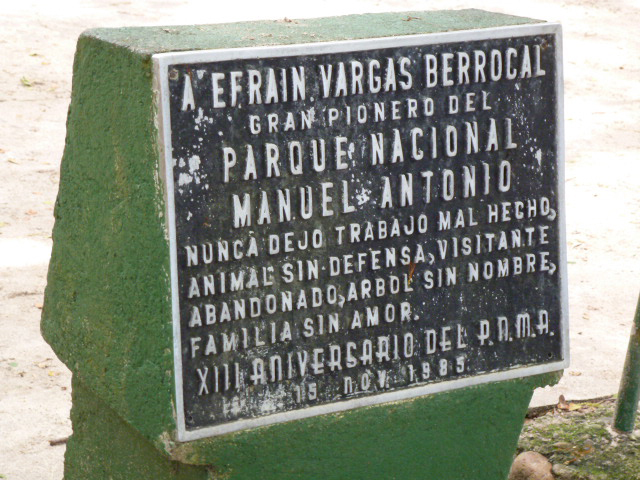
Our recent trip to Costa Rica included a visit to the pacific coast and Manuel Antonio, just south of Quepos. You can view pictures from our trip on The Costa Rica Star Facebook page.
The nation’s most popular National Park is the smallest, yet has abundant wildlife and some of the most beautiful beaches in Costa Rica. We met a local who was marketing the day tours and led us to the entrance to the park. When he noticed who our guide would be, he said, “You are lucky today”. As it turned out yes, we were. Our guide Efrain Vargas grew up on the land now known as Manuel Antonio National Park. His family owned the land until 1972, when a foreigner purchased it and would not let any of the people onto his property.
A group of locals petitioned the government to declare it a national park. His father, A Efrain Vargas Berrocal became the first park ranger. In 1985, while in the park a tree fell hitting and killing his father. A monument near the beach recognizes his contribution to the park. His son Efrain then thirteen made a vow that he would one day replace his father as a park ranger. Ten years later, he realized his commitment and served for five years.
Efrain then decided he could better share his vast knowledge of the land he loves by becoming a tour guide. This tour was unlike any we had previously experienced. His passion enthusiasm and knowledge made for a great time. He knew where to find the monkeys sloths, lizards, iguanas, frogs, crabs, snakes, unique flora, turtles and of course the many birds who make their home in the park.
There are 109 species of mammals, 184 of birds and both the two-toed and three-toed sloths are resident.
As we were walking on the trail, we heard a low screeching noise. He stopped us and said that it was a snake attacking a frog. Sure enough as we looked into a little gully there was a green vine snake trying to swallow a red eye tree frog. This type of frog spits at the snake’s eyes trying to blind it so he can get free. After several failed attempts, the snake reversed course, began to attack from the back of the frog and was successful in obtaining his meal.
Farther on down the trail Efrain spotted a yellow-eye-lash viper in a thicket just off the trail, which we would have all passed by without ever noticing. He carried a telescope on a tripod and based on certain noises located all types of creatures big and small. He took each of our cameras using the telescope and created many beautiful memories. On what was supposed to be a one and one half hour tour turned into almost three hours of historic information that you could never read in the many books available about this area. Such as why some banana trees still grow in the park but do not produce fruit. This is a jungle and very little sunlight seeps through the upper levels of the forest. Banana trees cannot survive without direct sunlight. In one small area along the path, the sun filters through and a single banana tree is reaching for the sky.
Along the way, he showed us a white building where he grew up and quickly turning around pointed out a two-toed sloth moving in the trees. When we arrived at the beach we stopped at his father’s monument, learned about what is was like growing up on this land. His father and grandfather raised cattle, various types of fruit and vegetables for the local markets. It was supposed to be the end of the tour, but Efrain heard from another guide that some white-faced monkeys were running around the beach looking for food to steal from the careless sunbathers. We continued on, first he spotted a long trail of leaf cutter ants. The ants carry pieces of leaves to an underground nest where they are converted into a fungus, which feeds the ants.
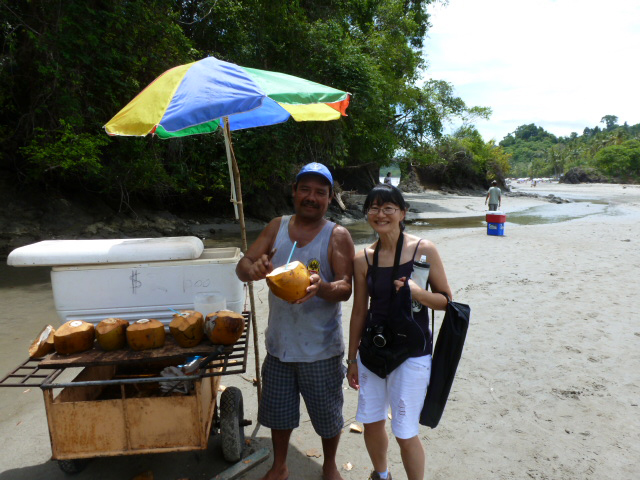
On down the beach trail he spotted several baby iguanas and stopped to describe their habits. Suddenly, we saw the white-faced monkeys running on the ground just in front of us. After watching them for five or so minutes, we shook hands, said goodbye and continued down the trail to the exit. We crossed a stream and met a vendor selling coconuts (picture above). He took a machete, chopped a hole and inserted a straw for a tasty cool drink. Later after a very nice lunch at the Marlin restaurant, we decided to go back into the park and do some exploring ourselves. It was fun but not like our tour. We could not find or see what was easy for our guide, we finally gave up and returned to await transportation back to Jaco. Our unusual luck on this trip was just beginning.



