


 SIGN UP FOR OUR
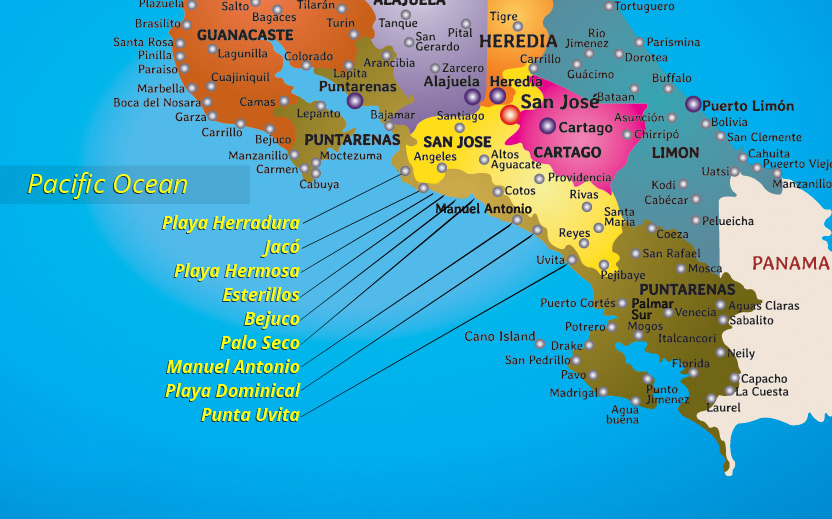
There is no doubt that Costa Rica is a land of contrasts, and few places demonstrate this more than the Central Pacific coast, where several mountain ranges meet the Pacific Ocean, creating some of the most spectacular landscapes one can imagine.
Stretching from the southern tip of the city of Puntarenas all the way down to Punta Uvita, the region offers something for everyone; from busy beach towns and great surfing spots to tranquil semi-deserted beaches. The area features wet and dry tropical forests and in the case of Manuel Antonio, one of the last low land tropical rainforests in Central America. Wildlife is abundant throughout the coast and it is definitely one of its biggest attractions.
Finding the right place for you to spend your vacation is not an easy task. To help you decide, we will highlight some of the most popular sites as well as some secret ones to make the decision process a little easier.
In this article, we will review the best features each of these beaches the Central Pacific has to offer, as well as mention what could be considered drawbacks. Each destination will include important facts which will provide an overview of the site, these include, distance from San José, driving times, access to airports, sand quality and other important information; we will also inform you of the amenities and tourist activities that are available in the general areas.
I would like to clarify, that our intent is not to determine which location is better than the rest, instead, we aim to give you relevant information for you to determine which location might be more suitable to you and your travel companions by showcasing each destination’s pros and cons we hope to shed some light for you to decide which one checks the most boxes depending on the experience you wish to enjoy.
There are countless beaches in the Central Pacific coast of Costa Rica, and it would be difficult to review each of these in this single article. Therefore, we will focus on the most popular and give you some insights of other lesser known sites to visit along the way.
The beaches mentioned herein are part of Costa Rica’s Tourism Hub, which extends from the Puntarenas Province down to the Southern Pacific region of the Osa Peninsula. This area is known for its valuable real estate opportunities. Take a look at our Real Estate Section for more information about this special region of Costa Rica.
Playa Herradura
This beach is home to the Marriot Resort Los Sueños which is also a marina. This is a quiet beach that offers a chance for travelers to relax while being very close to the Central Valley and other more active beach towns. Herradura which means horseshoe gets its name because of its location in a small horseshoe shaped bay.
Location: South of Puntarenas and north of Jacó
Distance from San José: 56 miles (90 km) 1 hour drive
Closest town: Jacó
Beach Status: Public beach
Type of Sand: Dark brown sand – smooth beach
Average temperature: 71 – 90° F (22 – 32° C)
Nearest Airport: Juan Santamaría International Airport
Selling Points:
1. Very close to San José, with easy access.
2. Relaxing environment.
3. Tranquil waters ideal for swimming.
4. Known for its sports fishing tours and golf.
5. Great for shopping.
Disadvantages:
1. Few hotels to choose from.
2. The beach itself is not the most beautiful in the area.
Recommendations:
It is best if you rent a car when visiting playa Herradura so you can travel to nearby beaches and towns that offer more tourist activities and dining options as these are not widely available in Herradura.
Additional Tips:
Taking a day trip to nearby Jacó beach to enjoy some of the amenities there is recommended.
If you are on a budget, consider some of the rental properties available in Playa Herradura that offer a more affordable stay.
Jacó
Possibly the most visited beach in Costa Rica because of its proximity to the Central Valley and the bustling party town. This beach has a unique vibe as Jacó is a mixture of local culture and ex-pat flare.
There is ample night life to be enjoyed and the surfing here is phenomenal. The tourism and real estate industry here are booming, and a lot of investment properties are available for those with an entrepreneurial vision. If you are interested in purchasing an investment property or simply a close to town beach hangout, make sure to visit our Real Estate section for tips and contact information.
Location: North of Manuel Antonio and South of Playa Herradura
Distance from San José: 73 miles (117 km) 1 hour and 30-minute drive
Closest towns: Jacó
Beach Status: Public beach
Type of Sand: Light brown sand -smooth beach
Average temperature: 71 -90° F (22 – 32° C)
Nearest airport: Juan Santamaria International Airport
Selling Points:
1. Jacó offers excellent year-round surfing, its proximity to the central valley, the good condition of the road and access to public transportation makes it very easy to visit.
2. There are plenty of hotels and restaurants and a great night scene for those who love a good party. Locals are friendly and welcoming.
3. Accommodations are available for all budgets from luxury resorts and rental homes to mid-range hotels and hostels.
4. Jacó is notorious for its sports fishing.
5. Carara Biological Reserve is close by, and makes for a great day trip.
6. Several beaches close by to visit
Disadvantages:
1. It gets crowded; because it is so easy to get to, a lot of people visit this beach, if you prefer the quiet secluded beaches then Jacó would not be the best choice.
2. Hard to experience the real Tico culture, in recent years so many ex-pats have relocated to Jacó that the vibe here is less Costa Rican than you would expect, and it does take away from the experience.
3. Not the most beautiful beach in the Central Pacific Coast.
Recommendations:
Jacó should be on your list of destinations if you love to surf and enjoy a good party. The road is in great condition and it is easy to reach for those who have rented a car, for those who have not, the public transportation system (buses) run daily several times a day which makes it easy and cheap to travel here.
Additional Tips:
When in Jacó, make sure to dedicate a day to go beach hopping to nearby beaches of Herradura and Playa Hermosa. If you enjoy nature and wildlife, then a visit to the Carara Biological Reserve is a must.
Playa Hermosa
I would like to make a little side note here, Costa Ricans have a tendency of re-suing names for different destinations. There is a Playa Hermosa in Guanacaste, but there is also one located just south of Jacó, and this is the one we are referring to here.
Playa Hermosa is an extensive beach, spanning a little over 4 miles. Although Hermosa is located very close to Jacó and Herradura it is still rather undeveloped and in our opinion this is what makes it so appealing. This is not say that there are no places to stay at, but rather these are not big resort or high-rises.
Known for its world class surfing, it hosts an annual surfing competition that attracts some of the best surfers in the world.
Location: South of Jacó
Distance from San José: 75 miles (121 km) 1 hour and 30-minute drive
Closest Town: Jacó
Beach Status: Public Beach
Type of Sand: Dark Brown – Smooth beach-
Average temperature: 71 -90° F (22 – 32° C)
Nearest airport: Juan Santamaria International Airport
Selling Points:
1. A lot of people visit playa Hermosa, but because it is so extensive you never feel overwhelmed by crowds.
2. The northern tip is where the hotels and restaurants are located the rest of the beach has been designated as a wildlife refuge.
3. The entire beach is backed by beautiful green hills where it is common to see flocks of red macaws, toucans, monkeys and other animals.
4. Great surfing spot, some of the best and most consistent breaks in the country are in Hermosa.
Disadvantages:
1. Swimming is not recommended because of strong under tows and rough surf.
2. Hotels are small and offer little amenities.
3. Not a lot of dining options.
4. Few tourist activities.
Recommendations:
If you are an experienced surfer, then playa Hermosa is one destination you should visit. This beach is recommended for travelers who are seeking a relaxed tranquil environment without a lot of the frills.
Additional Tips:
Playa Hermosa is a protected nesting site for the endangered Olive Ridley Sea Turtle, the turtles can be seen arriving to shore to nest during the months of July to December.
Esterillos, Bejuco and Palo Seco
South of Jacó and Hermosa there are several secluded and largely deserted beaches, some that are worth mentioning are Playa Esterillos which is divided in 3 sections, Oeste (West), Centro (Central) and Este (East), Playa Bejuco and Playa Palo Seco.
These beaches offer great surfing with no crowds, in fact, apart from Esterillos Oeste (West) which is inhabited by locals, you can walk for miles and not encounter another human being in these beautiful beaches.
Location: South of Jacó and North of Manuel Antonio
Closest towns: Jacó, Esterillos Oeste and Parrita.
Beach Status: Public
Type of Sand: Each of these locations has slightly different sand types, but, all of them are in the darker spectrums.
Average Temperature: 71 -90° F (22 – 32° C)
Nearest airport: Juan Santamaria International Airport and Quepos local airport
Selling Points:
1. No crowds, tranquil atmosphere.
2. Good surfing spots for experienced surfers.
3. Unspoiled beaches.
4. Great for wildlife watching.
Disadvantages:
1. Some of these beaches are not as easily accessible as Jacó and Hermosa.
2. Few options for lodging and dining.
3. Few tourist activities to enjoy.
4. Not suitable for swimming due to strong currents.
Recommendations:
These off the beaten path locations are ideal for travelers who are looking to get away from it all. It is possible to visit some or all of these on your way down to Manuel Antonio, as there is little to do here aside from enjoy the scenery there is no need to linger for long, unless you are looking for a good surfing spot.
Additional Tips:
If you would like to visit these beach towns, it is best if you rent a 4×4 vehicle as some side roads may not be in optimal conditions.
Manuel Antonio
Continuing south along the coast, we find the magnificent Manuel Antonio National Park, probably the most visited coastal National Park in Costa Rica, it is known for its lush and endangered low lands rain forest.
Manuel Antonio is perfect fusion of sandy beaches, coral reefs and local flare set amidst beautiful mountains covered in green.
Location: South of Palo Seco and north of Domical
Distance from San José: 106 miles (170 km) close to 3 hours and 30 minutes. If you are short on time you can fly into Quepos and take the bus to Manuel Antonio. Both Sansa and Nature Air offer daily flights to Quepos.
Closest Towns: Quepos
Beach Status: The National Park is comprised of 3 different beaches, Playa Espadilla which is a public beach at the entrance of the park, Playa Manuel Antonio and Playa Rey are within the limits of the park, and although visitors are allowed in, they must pay an entrance fee to the park.
Type of Sand: Playa Espadilla has light brown sand, while Playa Manuel Antonio and Playa Rey have white sand. All three beaches are smooth though.
Average Temperature: 81 – 90° F (27 – 32° C)
Nearest Airport: Juan Santamaria International Airport and the local airstrip in Quepos.
Selling Points:
1. Popular beach with tons of tourist activities.
2. Spectacular landscapes, and white sand beaches.
3. Lots of hotels and resorts that adjust to every budget.
4. Plenty of bars, restaurants and a fun night scene.
5. Hiking in the Manuel Antonio National Park is a must.
6. Several nearby secluded beaches including Playa Biesanz which offers great snorkeling.
7. Great vacation spot for Nature lovers, and members of the LGBTQ community.
Disadvantages:
1. A bit more remote than other Central Pacific beaches, but this could also be a plus for some.
2. Gets crowded during the summer months, and rains a lot during the months of August through November.
Recommendations:
1. The most budget friendly hotels are located in or close to Quepos, there is public transportation to and from Quepos to Manuel Antonio but the buses do not run 24 hours, so your visit can be cut short. For this reason, it is best to rent a car, preferably a 4×4 to drive around the area.
2. Plan to stay a few days in Manuel Antonio, there is a lot to see in the National Park and the surrounding areas, and there are a lot of fun tourist activities to be enjoyed, a day is simply not enough to take in this beautiful place.
Additional Tips:
Manuel Antonio is a great place to learn how to surf, boards can be rented in Playa Espadilla, so if you ever wanted to learn how to surf this is your chance.
Also, make sure to make your rounds to the smaller lesser known beaches, but be careful some, like Playa Playita are not accessible during high tide and if you are not careful you may be stranded there until the low tide comes.
Playa Dominical
Towards the end of what is considered the Central Pacific Coast, (some will argue South Pacific but it is still Central) you will find Playa Dominical. This large stretch of beach has become a popular hangout for surfers and yoga practitioners. It caters more to travels with a small budget than to those seeking a luxurious vacation.
Location: South of Manuel Antonio and north of Punta Uvita.
Distance from San José: 133 miles (215 km) it will take you about 4 and a half hours to drive there.
Closest Towns: Dominical which is a very small town and Quepos
Beach Status: Public beach
Type of Sand: Dark gray sand – the beach is part smooth and part rough, there is a lot of debris and rocks on the beach from a nearby river mouth.
Average Temperature: 78 – 90° F (25 – 32° C)
Nearest Airport: Quepos (domestic flights)
Selling Points:
1. The landscape surrounding Dominical seems out of a fairy tale, the mountains that line the coast merge seamlessly into the deep blue waters of the Pacific.
2. The town of Dominical is a quaint tranquil place, the locals are super friendly.
3. The beach is quite extensive and it is never really crowded, but even if it were you would not notice it.
4. It is home to Ballena National Marine Park.
5. There are lot of attractions nearby for wildlife enthusiasts, these include Mangrove forests, waterfalls and plenty of wildlife to see.
Disadvantages:
1. Although, there are plenty of small hotels, none of them are luxurious, so this is a destination that is better suited for low budget travelers or those who are looking for a more rustic vacation.
2. It is somewhat remote; the access roads are in good condition but there is not a lot available as far as dining or nightlife options.
3. Swimming is not advisable here, there are strong riptides that can pull even the most skilled swimmers out to sea.
Recommendations:
Dominical is not the most beautiful beach in the area, although it is charming and it does have a lot to offer to the right type of traveler. Mainly, if you are a surfer or an avid yoga practitioner then this destination may appeal to you.
Additional Tips:
A visit to the nearby beach of Dominicalito is recommended for those who wish to learn how to surf or just want to go for a swim. The waters are much calmer in Dominicalito than in Dominical.
Try to squeeze in a trip to the Ballena National Marine Park, the iconic sandbar here resembles the tail of a whale, and during certain months of the year, pods of humpback and pilot whales can be seen.
Punta Uvita
Punta Uvita is the last beach considered to be within the Central Pacific Coast of Costa Rica, any beach further south will be part of the Southern Pacific Coast. Some of these beaches include Drake Bay, Carate, Cabo Matapalo, and the beaches surrounding Puerto Jimenez in the Peninsula de Osa.
Uvita is situated within the Ballena National Marine Park and it is one of the most spectacular beaches in the region. The small town of Punta Uvita is a quiet, serene unspoiled place; just a few years ago, there were few hotels and amenities for travelers, but it is slowly becoming more and more of a tourist destination.
Location: 11 miles south of Dominical
Distance from San José: 144 miles (232 km) Close to 5 hours’ drive.
Closest Towns: Dominical
Beach Status: Public
Type of Sand: Light brown sand – Smooth beach
Average Temperature: 78 – 90° F (25 – 32° C)
Nearest Airport: Quepos
Selling Points:
1. Remote, secluded and unspoiled.
2. Waters are well suited for swimming.
3. There are some awesome snorkeling spots close to the coast and great diving locations further out.
4. From May through October the Olive Ridley turtle comes ashore on this beach to nest.
5. From December to April, pods of humpback and pilot whales visit these warm waters to mate.
6. The tranquil waters are great for kayaking and visiting the mangrove forests.
Disadvantages:
1. There are few lodging options available.
2. It is remote, if you would like to visit Punta Uvita, you need to plan for long drives, which means you will need to plan for at least a 2 day stay.
Recommendations:
This remote destination is suited for nature and especially marine life enthusiasts, however, beware that because the beach is located inside the Ballena National Marine Park, no fishing or hunting is allowed. Removing any life form from the area is also prohibited, but water sports are widely available.
Additional Tips:
There are some amazing waterfalls close to Punta Uvita, and we recommend you take a tour of them. If you are a diving aficionado, then make sure to inquire about the diving tours that are offered.
As mentioned above, there are a myriad of small, mostly unknown beaches lining the Central Pacific Coast of Costa Rica, and the best way to experience them is by renting a car and driving down the coast, stopping frequently to take in all the beauty this area has to offer.
Happy Travels!
For a detailed look at the best beaches in Guanacaste Costa Rica click here
For a detailed look at the best beaches in the Osa Peninsula Costa Rica click here
For a detailed look at the best beaches on the Caribbean coast Costa Rica please click here



