


 SIGN UP FOR OUR
 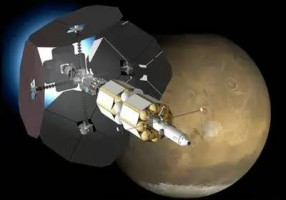 The Ad Astra Rocket Company, an aerospace business enterprise with research facilities in Costa Rica and the United States, recently announced the signing of a Support Agreement (Annex 6 – PDF) with the NASA Johnson Space Center to collaborate on aspects of safety, reliability and mission assurance related to the development of the Variable Specific Impulse Magnetoplasma Rocket (VASIMR) technology.
The signing of this annex is great news for Ad Astra, as it signals that it is maturing towards flight readiness. Costa Rica plays a significant part in the development of VASIMR. The Aurora space platform for the VASIMR system is being built here, and it will one day be deployed to the International Space Station in order to begin testing VASIMR and related technologies outside of Earth’s atmosphere.
The Aurora mockup was built at COVAO, a public vocational high school in Cartago, with the support of students and small engineering firms from the community. The financing and manufacturing of Aurora is 100 percent Tico effort, and the idea is to test VASIMR and Aurora at the Daniel Oduber International Airport in Liberia so that they can be exported to other space facilities right from Costa Rica.
The new agreement annex between the company that Dr. Franklin Chang-Diaz founded and NASA states in part that the parties will:
“[…] work together to examine, understand, and document the safety and reliability aspects of the VASIMR(R) technology and develop a design approach for the flight system that conforms to accepted NASA safety, reliability and mission assurance best practices.”
Other Space Exploration News
June has been a busy month for space exploration news. The success of the SpaceX/Dragon resupply mission to the International Space Station prompted Jared Squire, Ad Astra’s senior vice president for research, to call attention to his company’s relationship with NASA. Mr. Squire told Aviation Week that he is thinking of an approach similar to the one taken by SpaceX:
“If you have the surface-to-orbit capability in a reliable way, now you need an orbital transfer vehicle — a vehicle that can take large payloads and deliver them wherever in space efficiently. Electric propulsion in general has a capability to do that, and in the near term solar-electric has a lot of potential.”
Dr. Franklin Chang-Diaz once told The Costa Rica Star that partnerships between government space agencies and commercial aerospace outfits are the future of space exploration, and that he could see Ad Astra working with other commercial space enterprises in the future.
The United States Air Force is also looking at space as the final frontier… for spying. According to MSNBC, a mysterious spy aircraft is due to return to Earth some time this month. The X-37B has been in space orbit for over a year, and there are wild speculations about what the aircraft could have been doing up there all this time.



