


 SIGN UP FOR OUR
 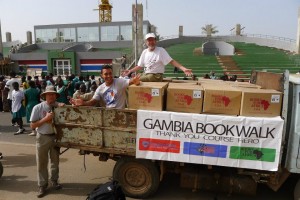 When Thomas Warth went to Africa in 1988, he was focusing on visiting a friend in Uganda and climbing Mt. Kilimanjaro in Tanzania. His goal was a bit higher, so to speak, than constantly thinking about books, even though books were his passion and life’s work.
Warth noticed during that fateful trip which included a visit to a local Ugandan library, that books there were practically non-existent. When he returned home from this discouraging scenario, Warth was inspired to coordinate Books For Africa, a non-profit organization whose mission is to collect discarded books from U.S. libraries, publishers, and schools to send to Africa. The original idea was quite simple, but the potential to help was incredible: recycle usable books destined for landfills and send them to African children starving for reading material.
Over the years, BFA has shipped ever-increasing loads of books and now, computers, to educationally deprived libraries, schools, orphanages, and community centers. Books are collected, boxed and prepared for shipping in the BFA warehouses in St. Paul, Minnesota and in Atlanta, Georgia. More than 27 million books have been shipped to 46 countries on the African continent since 1988.
It costs about $9,800 to send a sea container full of 22,000 books to an African seaport. That amounts to a huge fundraising effort on BFA’s part. By soliciting help from dignitaries in the countries most likely to benefit, fundraising events continue to be successful.
But just as those who benefit will tell you, a few books only make the children and adult learners hungry for more. It is through education that these people hope to rise above the desolate conditions of war and famine that have kept them down for so long.
Ever grateful for the assistance of this organization Kenyan Ambassador to the United States, Elkanah Odembo, served as keynote speaker for fundraising events in May of this year. His Excellency has also served the organization on its Board of Directors.
“There is not a single more important investment than that which we are making in education, absolutely none.” – Ambassador Elkanah Odembo
His Excellency Girma Birru Geda, Ambassador of Ethiopia to the United States, will be the honorary chair of the 2012 Books For Africa Summit Society.
Since its inception, BFA has garnered world-wide attention for its tremendous contribution to raising the level of education available to children in many of Africa’s poorest countries. Its goals reach deepest to those within the literary community who have a reverent appreciation for books.
“Books For Africa helps alleviate poverty of the imagination where imagination is most needed – where war and hunger, corruption and injustice seek to crush inspiration.” says Alexandra Fuller, author of the bestselling book Don’t Let’s Go to the Dogs Tonight
Warth has been a dealer in rare, antique and out-of-print books for many of his 76 years. Originally from England, he came to the US and settled in the Midwest where in 1987 he opened T E Warth Esq Automotive Books in St. Paul. He later founded MBI Publishing in nearby Wisconsin. Simply wandering through his quaint shop transports a lover of the written word back to a time when books were eloquent and powerful.
Shortages of books, educational material especially, are not unique only to African countries. While maybe not as acute, the same problem exists in Costa Rica as is evidenced by most, if not all, schools buying a single copy of a book, then photocopying the pages for the students. Even larger book dealers will sometimes sell photocopied copies of books. The costs of educational material are higher as each printing edition produces fewer copies, hence the higher cost.
Larry Coulter, of Goodlight Books in Alajuela posits that the rarity of printed materials in Costa Rica is due to a more complex set of challenges. Higher printing costs from local publishers and duties and shipping costs on books from foreign sources add to the cost per book and discourage readers from purchasing them. Often, the cost of a paperback can run as much as a hardcover copy in the U.S. which is why stores like Goodlight are so popular. Larry specializes in English language books with a small selection in other languages. Offering mostly used material keeps his prices competitively low. Even so, with readership down, it is a struggle to stay in business.



