


 SIGN UP FOR OUR
With different sources simultaneously publishing magnitudes of varying degrees, headlines clashed throughout the Internet on Sunday evening, November 12, when an earthquake rattled much of Costa Rica. The tremor was also felt in Panama.
The Jacó earthquake, which occurred off the coast of the the central Pacific tourist town, was eventually pegged as a 6.5 magnitude quake by scientists at the Volcanology and Seismology Observatory at the National University of Costa Rica (Ovsicori), after having been reported initially by the observatory as 6.8, and later as 6.9 on the Richter scale. This is the generally accepted official magnitude of this most recent strong earthquake, which is the largest since the 7.6 magnitude earthquake in Nicoya in 2012.
What is for sure is that three individuals had the daylights literally scared out of them, and died from heart attacks in the aftermath of the tremendously powerful event.
A woman, Teresa Viales Navarro, 56, and a man, José Alberto Segura Gutiérrez, 54, both from the Jacó area, died in separate incidents after being rushed to the Puntarenas Hospital for heart attacks that apparently were triggered by the earthquake.
And finally, a young man in Coronado, a suburb of San José, Jean Carlo Zúñiga, 25, also died of a heart attack as a result of the earthquake’s unsettling disturbance.
According to earthquake experts at Temblor.com:
“The subduction of the Cocos oceanic plate beneath the Caribbean continental plate at an approximate convergence speed of ~85 mm/year along the Costa Rican Pacific coast is one of strongest earthquake generating situations and has the greatest destructive potential in the country. An example of this is the recent earthquake in Nicoya, MW = 7.6, on September 5, 2012, which occurred about 50 km northeast of the epicenter of the Jacó earthquake Sunday night. The subduction zone in the central pacific of Costa Rica is one of the most active seismic regions of the country generating dozens of events of low magnitude daily.”
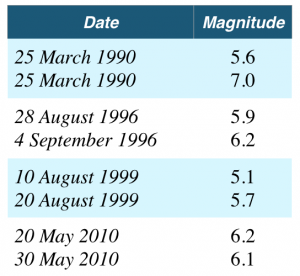
The experts also compiled a list of double seismicity that has occurred in the Central Pacific region.



