


 SIGN UP FOR OUR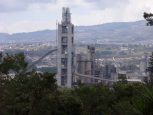
The Holcim plant in Lourdes, Agua Caliente, Cartago, source Facebook.
By Wendy Anders
In Lourdes de Agua Caliente, Cartago, the air, trees, roofs, cars, and houses are regularly bathed in dust. And it isn’t the Turrialba Volcano’s fault this time.
This ongoing saga which is having serious health implications for the small town, was reported on yesterday by Costa Rica’s Repretel TV station.
The station aired videos taken on Friday and Saturday by residents that show giant white-gray clouds of dust floating over the community from the Holcim cement factory in their town.
The Ministry of Health visited Monday and ordered the plant to control the dust emissions, said Repretel.
Residents who spoke with the station on Repretel’s “Denuncia Comunal” (Community Complaint) program said the clouds of dust started about three years ago and have been a regular occurrence since then.
In February, AMPrensa.com called Lourdes the most polluted place in Costa Rica due to the air pollution., saying last year 2,306 of the town’s 4,245 residents reported some type of respiratory infections.
A health worker at the Lourdes public health clinic told Repretel there is an unusually high incidence of chronic pulmonary disorders, asthma, and allergies among the town’s children and elderly.
A company official was interviewed and offered that the “dust is from primary materials, limestone rock, which doesn’t cause any environmental or health damages.”
Meanwhile, the U.S. Material Safety Data Sheet (MSDS, the official source for classifying hazardous materials) for limestone lists it as an irritant:
- Limestone is odorless and white or grayish in colour. Contact with pulverized limestone or limestone dust can cause irritation to eyes, skin, respiratory system, and gastrointestinal tract.
- Contact with pulverized limestone or limestone dust may cause irritation of the eyes.
- Contact with pulverized limestone or limestone dust may cause dryness and irritation of the skin.
- May cause discomfort or constipation if swallowed. If large quantities are swallowed, it may cause nausea, hypercalcaemia or hemorrhage.
- Inhalation of pulverized limestone or limestone dust may cause irritation of the respiratory system resulting in coughing and/or sneezing. Higher exposures may cause a build up of fluid in the lungs with severe shortness of breath.
In addition, chronic exposure to limestone dust, which is made up of calcium carbonate, magnesium carbonate, and silica, “at concentrations exceeding occupational exposure limits, may cause pneumoconosis (lung disease). Prolonged or repeated inhalation of respirable crystalline silica can also cause a lung disorder, silicosis,” according to the MSDS.
Repeated reports of the problem affecting the small town of Lourdes have been documented in local media, but no lasting solution has been found for the dust-coated residents.
According to Wikipedia, Holcim is a Swiss-based global building materials and aggregates company and a market leader in cement production in Australia, Azerbaijan, India, Slovakia, Switzerland, and Latin America. As of 2014, Holcim was doing business in more than 70 different countries and employed 71,000 people.



