


 SIGN UP FOR OUR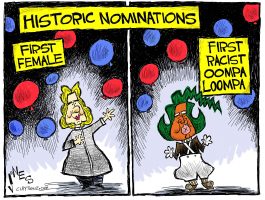
Cartoon by Clay Jones
Since the 18th century, news readers have found some of the most incisive, acerbic and brutally honest commentary about current affairs in the form of political (editorial) cartoons.
Regrettably, political cartoons in the 21st century have been in a state of demise that many believe is related to the death of printed newspapers; however, the death of editorial cartoons in English language media has more to do with what U.S. cartoonist and columnist Ted Rall describes as “corporate slacktivism,” an aversion to rocking the boat with satire.
In recent years, political cartoonists have dealt with the closure of newspapers, cost-cutting, a migration towards digital media, violence, and even murderous terrorist attacks. The combination of these factors in the have resulted in a self-imposed censorship of satire by English language news media executives who are afraid that a caustic cartoon will move online readers to post negative comments instead of clicking on the thumbs-up “Like” button.
The Costa Rica Star features the work of Clay Jones, a syndicated cartoonist from the United States whose blistering liberal commentary is considered perceptive by some readers and offensive by others. Mr. Jones has also produced work commissioned by The Costa Rica Star in the form of cartoons that make fun of expat life in our country. We asked Mr. Jones to comment on the state of his craft, and we also asked our political columnist, Britt Nelson, to tell us about his 20-plus years of experience handling cartoons as a newspaper editor in the U.S.
Mr. Jones is a survivor from the newsprint era:
I was laid off in 2012 after 15 years at The Free Lance-Star in Fredericksburg, VA. I’ve spent over 20 years in this business, having been on staff in Virginia, Hawaii, and Mississippi.
Newspapers are still profitable, but part of this profit-making scheme consists of laying off staffers, and cartoonists are always included in this layoffs. We’ve gone from over 100 staff cartoonist positions about a decade ago to maybe around 30-40 today in the U.S.
The ironic thing is, cartoons are still popular; however, newspapers are afraid of anything that’s not just controversial, but that might even get one negative response. Today, I sell my work to over 50 newspapers; while I continue to gain clients, I lose them every now and then. I don’t just lose them because I’m liberal, but just for the fact my work has an opinion. If I drew nothing but positive, happy cartoons, or cartoons about dead celebrities at the Pearly Gates, I’d have more clients.
When I lost my job, I decided to quit my syndicate and start my own. I wasn’t going to be in business just to be in business. I want to be able to draw what I want to draw. Whoever wants to come along for the ride is welcome. But I don’t have a salary or 401K anymore and I’m not going to let editors tell me what to draw.
I still hope to have a career at this. I’m trying really hard. My biggest wish is to receive another job on a newspaper staff but honestly, I don’t know if that will ever happen again.
Mr. Nelson knows about editorial cartoons. He retired from the U.S. newspaper industry just at the time the Internet killed newsprint. The historical cartoons that accompany this article are from the 18th century and come from his private collection:
Editorial cartooning began in London in the 1700s. In the 1840s, the weekly Punch Magazine and other publications noticed that cartoons elicited public reaction, which brought in more advertising cash.
The public likes to see fun being made of their local politicians and other public figures; this sentiment goes back to the days of comedies in ancient Greece. This line of satirical thinking gave birth in 1954 to the Tonight Show with Steve Allen on national TV, then came Jack Parr and Johnny Carson and the rest is history – reporting of current affairs by means of satire became an important part of life.
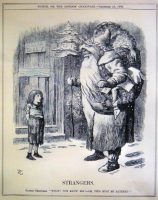
Back in the 1880s and 1890s, one Punch cartoonist used the same homeless, street-dirty little girl about 9 or 10 years old to illustrate society’s ills. Dozens and dozens of cartoons featured the same little girl. A Hollywood movie remains to be made about that little girl. One such cartoon had her meeting Santa Claus on the street and not knowing who he was. It’s entitled “Strangers.” This cartoon today is a classic example of standalone editorial cartooning. Back then a picture was worth much more than a thousand words.
Having worked in print newsrooms for 30-plus years in small towns and large cities, the value of a really great standalone editorial cartoon was easy to measure when you had to design that day’s editorial page.
A great cartoon could carry the whole page. Other times, when topical cartoons were not available, we would use a single photo to illustrate an issue. There was one time I published a photo of the parking lot at Dunkin’ Donuts at 6am, and there was nowhere to park because of all the police cars. No words went with that photo, but it told a story and delivered a sharp comment, which is what political cartoonists do to inform and amuse us.
A great editorial cartoonist in this day and age must be a really bright news junkie with quick wit and artistic impressionism skills to be able to come up with something on deadline. In this sense, cartoonists are just like reporters, photographers and editors who put together what you read.
Punch cartoons often stood alone and illuminated issues. Some, of course, illustrated stories of the times just like editorial cartoons do today in print publications and on-line as well. Print publications, as we all know, are declining due to the digital age. But cartoons will live on, I hope, thanks to online social networking and the resilience of cartoonists.
Political Cartoons Are Funny; Violence and Murder Are Not
Cost-cutting and the fear of ruffling Millennial feathers is one thing; hatred and violence is another. The 21st century has brought about terrorist attacks and senseless murders of political cartoonists.
As reported by The Costa Rica Star in January 2015, the offices of French publication Charlie Hebdo, known for its unabashed and Punch-like cartoons that ridiculed Islamic militants, were targeted by gunmen who sought to kill cartoonists. It is interesting to note that the Nicaraguan government would later deny entry to a French cartoonist who survived the Charlie Hebdo attack.
In 2012, the Syrian regime of despotic leader Bashar Al Assad detained editorial cartoonist Akram Raslan, whose biting cartoons depicted Assad as the homicidal and oppressive fool he is. Later, Raslan would be honored with the Cartoonists Rights Network International award for his courage. By late 2013, Raslan was reported missing and presumed to have been killed by the regime.
Mr. Jones comments on the Charlie Hebdo attack:
I thought it was terrible. We get occasional death threats here in the U.S., but I can’t recall any time an attempt has been made on a U.S. cartoonist’s life during my career. I don’t really see why we would either as most of the stuff produced here is very soft.
I think there’s maybe about ten U.S. cartoonists who are doing challenging, irreverent stuff and I hope I’m one of them. Most cartoonists here are recycling the same ideas and cliches. If an editor runs a cartoon that actually gets a lot of negative responses, they apologize for it the next day.
While I don’t think U.S. newspapers should run cartoons just to make people angry, they shouldn’t be afraid of it as a result of making their readers think. Newspapers used to like content that would get a reaction, even negative. Now it’s like newspaper editors are afraid people might actually read their newspapers.
What Makes Political Cartoons So Inflammatory?
Writing for The New York Times in 2011, Victor Navasky wrote about the reaction to the early run of Charlie Hebdo cartoons that satirized radical Islamic beliefs. Back then, the Charlie Hebdo offices had only been targeted once by a weak Molotov cocktail attack:
The debate on free speech versus taking into account the religious sensibilities of oppressed minorities (and majorities) is an important one. But nobody is talking about why it is that people become so agitated by cartoons and caricatures — a medium that so many dismiss as silly, trivial and irrelevant.
Neuroscientists and Freudians all have their explanations as to why and under what circumstances people [find political cartoons] so threatening.
For years anthropologists, art historians and others have patronized so-called primitive peoples as naïve heathens, as guilty of fetishism, animism and totemism because they believed that pictures had magical powers, that in some sense they were alive. Neuroscientists tell us that if we want to understand our emotional reaction to what we see, we have to understand the brain, its right (emotional) and left (rational) spheres and how the visual stimulus passes on the information to the region called the amygdala, the brain’s so-called fear center.
So we have anthropology and neuroscience explaining why we get so worked up about political cartoons, at least more so than we do when we read editorial articles. Could these explanations justify the fear by English language news media of publishing cartoons that are too honest, politically incorrect and controversial? Mr. Jones has an opinion on this issue:
I do feel that newspapers are afraid. To be honest, most editors don’t know a good cartoon when they see it. They love obituary cartoons. They love the most obvious.
The laziest cartoonists draw the same old cliches of sinking ships, candidates as Pinocchios, people going over ledges, etc… and those cartoons get a LOT of reprints. Check out USA Today every Friday. Most newspapers reprint cartoons and don’t have a staff cartoonist.
The Thought Process of a Political Cartoonist

Cartoon by Clay Jones
For this article, we asked Mr. Jones to explain how he created a specific cartoon published by The Costa Rica Star following the Brexit referendum vote for the United Kingdom to leave the European Union.
In this brilliant, one-panel cartoon, a British man explains Brexit with a racist tirade while downing pints at the local pub. The cartoon uses regional slang and profanity to get to the bottom of what truly motivated the British “Leave” voters: xenophobia.
I was watching the results of the Brexit and I had already done one cartoon on the subject. Then I thought how it seemed a lot of really ignorant, hateful people were voting in the UK just like they do in the U.S. Then I heard Donald Trump’s ignorant comments on the matter.
I tried to think of the most bizarre ideas and I wondered how a racist Trump supporter would sound in a London pub. I knew most of the slang but I did a little Googling… actually a lot of Googling. I visited over a dozen sites looking for the right words to fit the context.. and that would be safe for an American newspaper.
I attempt to make humor my best weapon and I was very amused with this one. Sometimes I only amuse myself with my cartoons.
Earlier this year, Mr. Jones switched from drawing cartoons on paper for subsequent scanning to creating them digitally with a Microsoft Surface tablet. It so happens that a significant amount of publishing for The Costa Rica Star is also done on a tablet: a Chinese Rockchip running Android KitKat.
Can the Internet Save Political Cartoons?
For a retired newsman such as Mr. Nelson, the Internet seems like the perfect medium to keep the spirit of political cartooning alive. Unfortunately, the reality told by cartoonists is different. In early 2015, Ted Rall wrote:
There is still powerful political cartooning online. Ironically, the Internet contributes to the death of satire in America by sating the demand for hard-hitting political art.
Before the Web, if a paper canceled my cartoons they would receive angry letters from my fans. Now my readers find me online — but the Internet pays pennies on the print dollar. I’m stubbornly hanging on, but many talented cartoonists, especially the young, won’t work for free.
It’s not that media organizations are broke. Far from it. Many are profitable. American newspapers and magazines employ tens of thousands of writers — they just don’t want anyone writing or drawing anything that questions the status quo, especially not in a form as powerful as political cartooning.
Mr. Jones shares a similar sentiment:
Some of the largest newspapers in the country (some are clients of mine) do not have staff cartoonists. Newspapers such as The Seattle Times, Dallas Morning News, Tampa Bay Times, Denver Post, Orange County Register, St. Louis Post-Dispatch, San Jose Mercury-News, Detroit News, New Orleans Times-Picayune, Ft. Lauderdale Sun-Sentinel, Milwaukee Journal-Sentinel, San Antonio Express-News, Austin American-Statesman, Fort Worth Star-Telegram, The Oklahoman, Louisville Courier-Journal, Cincinnati Enquirer, Hartford Courant, Richmond Times-Dispatch, Nashville Tennessean, Memphis Commercial Appeal, Jacksonville Times-Union, Las Vegas Review-Journal, Birmingham News, Des Moines Register, Honolulu Star-Advertiser, many of which had long histories of having a staff cartoonists who would produce cartoons on local issues and deliver Pulitzer prizes to their newspapers.
The thing is, newspapers don’t have to spend a fortune on a cartoonist or even compromise their stock options. Having a staff cartoonist is one of the best ways to provide locally produced content, on local issues, to your readers. Many of these newspapers have more than one sports columnist or a guy writing each week asking their readers which restaurant in town sells the best cheeseburger.
Writing for the Australian Broadcasting Corporation, acclaimed cartoonist Rocco Fazzari explained how the Internet disrupts his craft:
Today’s political cartoonists are not only threatened by the closure of newspapers, we are also competing with the super-slick memes that can be produced free on the net by the citizen reader, who in some cases is just as clever.
The traditional cartoon in the digital sphere also has to contend with the assumption digital producers will opt for flashy memes/gifs over static images to keep the page “alive”.
In many cases, producers have pilfered the meme/gif from someone’s Facebook post, or it was sent to the paper by a reader almost certainly at no cost.
In the end, Mr. Jones think that online commenting systems and Millennial attitudes towards news content are also to blame for the death of political cartoons.
People do get angrier now about political cartoons. Maybe it’s the Internet and the ability to bitch anonymously. It would always amaze me that my editors would panic and go into crisis mode over a comment that someone left with the anonymous handle “Boner4U.”



