


 SIGN UP FOR OUR
 By Wendy Anders
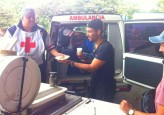
Source: Red Cross of Costa Rica
After waves of Cuban migrants cruised over the CR-Panama border late last year and earlier this year, and in recent months as the trickle of irregular migrants from Africa, Asia, Haiti and other countries has turned into a sizeable group now parked on the northern border seeking routes northward, Costa Rica’s governmental agencies are taking matters more seriously, said official sources in a press document yesterday.
The President’s office announced increased police presence on the country’s southern border with Panama to avoid surreptitious crossings. In a police operative that starts today, those who manage to cross but do not have their paperwork in order will be deported. And those with proper documentation and who have been allocated a visa will receive better humanitarian assistance, the office stated.
Likewise, the Planning Ministry is undertaking a multi-institutional process to design a medium- and long-term policy towards irregular migrants. This shall be ready in two months time.
Also supporting the effort to manage this new and growing problem, the Foreign Ministry is actively seeking regional and international agreements to help control and manage the flow of irregular migrants in the region.
The Costa Rican government extended their deep concern following the death of eight extra-continental migrants in Nicaragua who were recently reported as drowned, according to official government sources.
A recent agreement reached with the United States for Costa Rica to provide assistance and temporary residence to 200 migrants as they await for paperwork to enter the U.S. relates to people fleeing violence and human rights persecution in the northern triangle of Central America comprising El Salvador, Guatemala and Honduras. These migrants will arrive in Costa Rica through a formal process, and the agreement does not cover migrants who show up on the country’s borders.
Communication Minister, Mauricio Herrera, said, that those migrants who have recently managed to slip over the porous Panamanian border are granted 25-day temporary permits, and receive basic humanitarian attention at Temporary Migrant Attention Centers (CATEM, in Spanish).
However, the two centers located in the southern border area at Kilómetro 20 and Buenos Aires, and at El Jobo and Las Vueltas near the northern border are unauthorized, continued Herrera, and do not have the minimal requirements for tending to migrants. The government will not allow people to inhabit these areas, he said.
In the meantime, while plans are formalized, dozens of agencies including the Red Cross, the National Emergency Commission, the Health Ministry, the National Women’s Institute, and others are attempting to ameliorate the situation on the northern border which represents, “A latent danger, and needs to be taken into consideration,” according to Herrera.



