


 SIGN UP FOR OUR
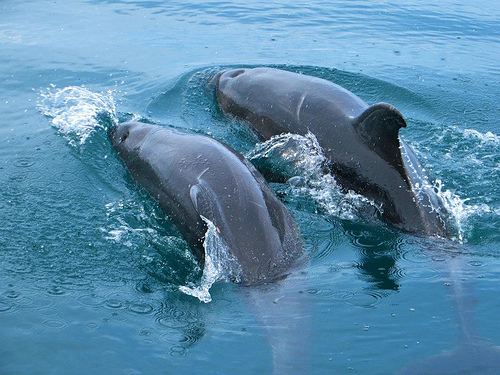
“Dogs barking after midnight,” remembers David, “the dogs went crazy every time a humpback whale blew or there were whales breaching right at Rincon Bay”. Those are the memories of David Herra Miranda, who was born and raised in Golfo Dulce. Now, more than two decades later, he is a research associate with CEIC, Centro de Investigación de Cetáceos Costa Rica (Cetacean Research Center Costa Rica).
“It was a true paradise”, David continues, remembering a place blessed by marine life during his childhood – a “place full of life”. David is one of the luckiest field biologists in the world. He has lived all his life in one of the best preserved coastal marine ecosystems of Costa Rica’s Pacific, one of the only three so called “tropical fjords” in the world. He works with whales and dolphins living in the gulf, documenting their daily life.
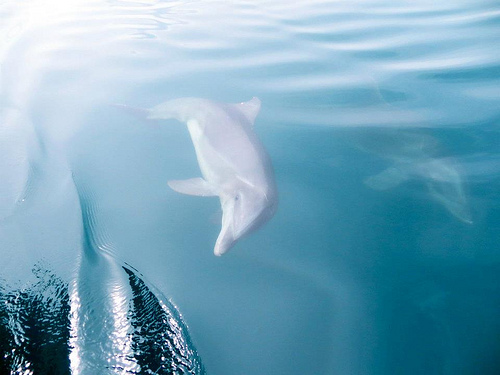
According to David, “We not only need to know what we got there in terms of species residing or passing by Golfo Dulce, we also need information of how many of them are out there, what do they do (to survive) and where do they concentrate to do whatever they do here in Golfo Dulce”. Those have been the main questions that have driven the research of CEIC in Golfo Dulce for over eight years: determining the diversity of whales and dolphins, including those that only migrate seasonally such as the humpback whales, the estimation of a population size of resident bottlenose and spotted dolphins, and the sound description of their behavior and habitat use.

Pinpoint location of the Golfo Dulce in Costa Rica
Chill Expeditions, an educational travel company with nearly 30 years of experience creating Eco-Immersion expeditions for families, and organizing teacher and student educational tours, is proud to collaborate with David and the CEIC, offering visitors a chance to be a scientist for a day (or longer), working hand in hand with David in his field research and contributing to this important effort.
Visitors learn research techniques and immerse themselves in the beauty of this stunning environment, all while staying at El Chontal, a beautiful eco-lodge run by David’s family. Visitors can join alongside David and the research team in observing and recording the natural behavior of the groups of whales and dolphins in the Gulf for an unforgettable experience.
“Basically…” explains David “…we use the nick and notches of the dolphins’ dorsal fin as their fingerprints, in a way that we can identify individuals and accurately count the number of individual dolphins in a population”. This behavior sampling serves to build up the life history of individual dolphins in their critical habitat.
For the whales and dolphins, these key areas includes places where they forage, areas where they chase and capture prey, places where they gather to socialize and get together for courtship and reproduction, and locations where they seek shelter for their babies.
“All these happen right here” explains David, “Golfo Dulce is a huge restaurant for our two species of resident dolphins. Bottlenose dolphins seek and capture prey at the mouth of all major rivers flowing into the inner basin of the Gulf, while spotted dolphins gather and consume schooling fish at the deepest portion of the same inner basin”.
For conservation and management, this kind of key scientific data is the staple to inform official management plans and the best tool to design strategies to face major conservation challenges.
The most attractive feature of Golfo Dulce, the incredible scenic beauty of the whole seascape, is precisely what increases the likelihood of human threats to the ecosystem. “There are plans to build up a luxury marina for more than 300 boats right next to the main nursing critical habitat of humpback whales in Golfo Dulce” points out David, “Imagine the increase in boat traffic and underwater ambient noise, exactly where the majority of mother humpback whales gather with their calves to seek protected calm waters. This is like putting a bar or night club next to the day care in the center of the town”.
Acoustic data gathered by CEIC team also indicates that male humpback whales gather at the sill area, the main channel that links the inner basin of Golfo Dulce with the open Pacific Ocean, to sing and attract females. “It is part of their courtship, ”explains David, “A song is a structured vocalization type made up of units, those units make phrases that connected and repeated in a pattern, become the entire song”.
Presumably, the richer the amount of units, the more complex and attractive the song is for potential mate. It is documented that the increase in ambient noise by boat traffic, as would be expected if the marina plan is successful, directly affects singing humpback whales: males will produce songs with fewer units, shortening the song cycles or abandoning the singing location. “We are disturbing their process of courtship and reproduction, naturally it will eventually imply a reduction of the population size”, reveals David.
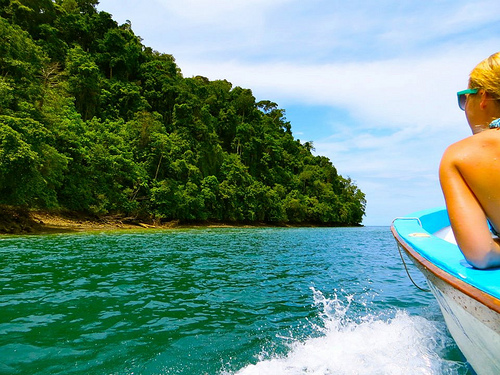
David and his colleagues believe that the future of Golfo Dulce lies in positive sustainable development. Chill Expeditions is proud to collaborate with conscientious eco-tourism efforts such as El Chontal and to offer our clients on our student educational tours the opportunity to participate in and contribute to the long-term preservation of some of the most precious natural wonders of Costa Rica.
As David says, “I want my kids to see what I was able to see, I want them to experience the whales and dolphins the way I do now, to have the same blessing I have had”. Local pioneers such as David and his team who work tirelessly to share their knowledge and protect this area are key to making sure this hope comes true.
Chill Expeditions would like to thank David Herra Miranda and Lenin Oveido for their contributions to this article and their professional collaboration.
Crawford Hill is the owner and director of Chill Expeditions, an educational travel company focused on cultural immersion. An expedition leader, former biology teacher, and educational innovator, Hill has been guiding students and adults on wilderness adventures since 1974. Over the years, Hill has led thousands of students and families on experiential learning trips to Costa Rica, Belize, the Galapagos Islands, Peru and Spain. Hill revels in the opportunity to be able to work with students and families across the country with the world as his classroom.



